

Table of Contents
As solar energy adoption continues to grow, homeowners and businesses are often faced with an important decision: should they choose a grid-tied solar system or an off-grid solar system? Understanding the differences between these two solutions is essential for selecting the most cost-effective and reliable option.
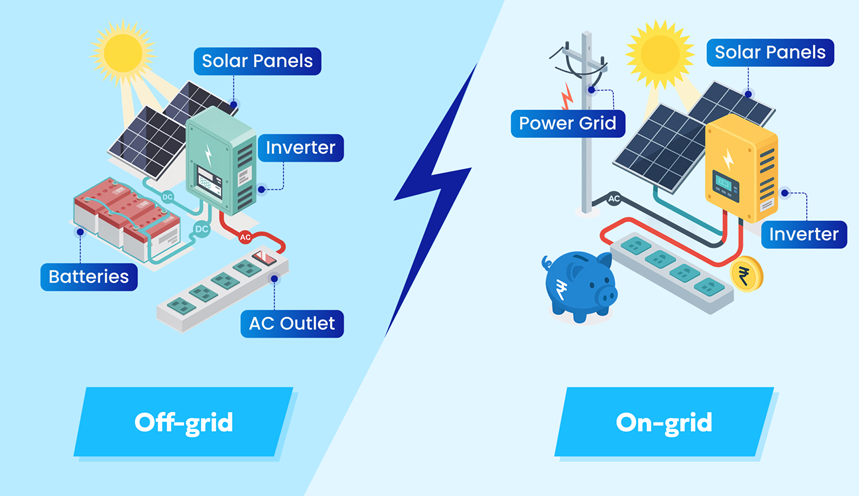
A grid-tied solar system is connected to the local utility grid. It allows users to generate electricity from solar panels while still drawing power from the grid when needed. This type of system typically requires fewer components and lower upfront investment, making it the most common solar solution worldwide.
An off-grid solar system, on the other hand, operates independently from the utility grid. It relies on solar panels, battery storage, and other equipment to provide a continuous power supply. While off-grid systems offer complete energy independence, they generally require a higher initial investment due to the need for battery storage and backup power solutions.
While both systems can deliver significant energy savings, their costs, benefits, and ideal applications vary depending on whether they are used for commercial and industrial facilities or residential properties. Below is a comparison from both commercial & industrial (C&I) and residential perspectives.
Commercial & Industrial Applications
For businesses, factories, warehouses, and industrial facilities, grid-tied solar systems are generally the most cost-effective option. Since the system remains connected to the utility grid, businesses can use solar power during the day and draw electricity from the grid when needed. This eliminates the need for large battery banks, significantly reducing upfront costs.
A typical grid-tied commercial solar project mainly includes solar panels, inverters, mounting structures, and grid connection equipment. The lower investment often results in a faster return on investment (ROI), especially in regions with high electricity prices or net metering programs.
In contrast, off-grid commercial systems require substantial battery storage to ensure continuous operation when solar generation is unavailable. Businesses with high energy consumption may need large-capacity battery energy storage systems (BESS), backup generators, and advanced energy management systems. These additional components can increase project costs considerably.
However, off-grid solutions are valuable for remote industrial sites, mining operations, agricultural facilities, and locations where grid access is unavailable or unreliable. In such cases, the higher investment can be justified by improved energy security and operational independence.
| Comparison Item | Grid-Tied Solar | Off-Grid Solar |
| Initial Investment | Lower | Higher |
| Battery Requirement | Optional | Required |
| System Complexity | Moderate | High |
| Electricity Cost Savings | High | High |
| Energy Independence | Low | Complete |
| Maintenance Cost | Lower | Higher |
| ROI Period | Shorter | Longer |
| Best For | Factories, warehouses, offices, commercial buildings | Remote facilities, mines, farms, off-grid operations |
| Grid Connection | Required | Not Required |
| Power During Grid Outages | No (unless paired with storage) | Yes |
Residential Applications
For homeowners, grid-tied solar systems are also the most common choice due to their affordability and simplicity. A residential grid-tied system typically requires only solar panels and an inverter, making installation costs relatively low. Homeowners can use solar energy during the day and rely on the grid at night, reducing electricity bills without the expense of battery storage.
Off-grid residential systems involve additional costs for batteries, charge controllers, and backup power equipment. Depending on household energy consumption, battery storage can represent a significant portion of the total project cost. Maintenance and battery replacement expenses should also be considered over the system's lifetime.
Despite the higher cost, off-grid systems offer complete energy independence. They are particularly suitable for remote homes, cabins, farms, and properties located far from utility infrastructure. For homeowners seeking reliable power in areas with frequent outages, off-grid systems can provide greater resilience and peace of mind.
| Comparison Item | Grid-Tied Solar | Off-Grid Solar |
| Initial Investment | Lower | Higher |
| Battery Requirement | Usually Not Required | Required |
| Installation Cost | Lower | Higher |
| Electricity Bill Reduction | Significant | Eliminates utility bills |
| Energy Independence | Partial | Complete |
| Maintenance Cost | Lower | Higher |
| System Expansion | Easier | More Complex |
| Best For | Urban and suburban homes | Remote homes, cabins, farms |
| Grid Connection | Required | Not Required |
| Backup Power Capability | Limited | Full-Time Power Supply |
Which Option Is Right for You?
For both commercial and residential users, grid-tied solar systems generally offer lower upfront costs and faster financial returns, making them the preferred option where reliable grid access is available.
However, off-grid solar systems provide unmatched energy independence and reliability in remote locations, making them a valuable investment for users who cannot depend on the utility grid.
| Quick Summary | |
| Factor | Recommended Solution |
| Lowest Upfront Cost | Grid-Tied Solar |
| Fastest ROI | Grid-Tied Solar |
| Maximum Energy Independence | Off-Grid Solar |
| Reliable Power in Remote Areas | Off-Grid Solar |
| Urban Residential Projects | Grid-Tied Solar |
| Commercial Facilities with Grid Access | Grid-Tied Solar |
| Remote Industrial & Agricultural Sites | Off-Grid Solar |
The best choice ultimately depends on your location, energy consumption patterns, budget, and long-term energy goals. By carefully evaluating these factors, you can select a solar solution that delivers the right balance between cost savings, reliability, and energy security.
Frequently Asked Questions
1. Is a Grid-Tied Solar System Cheaper Than an Off-Grid Solar System?
Yes. In most cases, grid-tied solar systems have lower upfront costs because they do not require large battery storage systems. Off-grid systems need batteries and additional backup components, which significantly increase the overall investment.
2. Do Off-Grid Solar Systems Always Require Batteries?
Yes. Since off-grid systems are not connected to the utility grid, battery storage is essential for supplying electricity during nighttime and periods of low solar generation. Without batteries, a stable power supply cannot be maintained.
3. Which Solar System Offers Faster Return on Investment?
Grid-tied solar systems generally provide a faster return on investment (ROI). Their lower installation costs and ability to offset utility electricity consumption make them a more cost-effective option for most homes and businesses.
4. Are Off-Grid Solar Systems Suitable for Commercial and Industrial Facilities?
Yes. Off-grid solar systems are ideal for remote industrial sites, farms, mining operations, and other locations where grid access is unavailable or unreliable. They provide energy independence and reliable power in challenging environments.
5. How Do I Choose Between a Grid-Tied and an Off-Grid Solar System?
The best choice depends on your location, energy consumption, budget, and power reliability requirements. If you have access to a stable utility grid and want lower upfront costs, a grid-tied system is usually the better option. If energy independence is a priority or grid access is limited, an off-grid system may be the most suitable solution.