


المحتويات
Buying solar panels in 2026 is about more than finding the lowest solar panel price. With technologies such as TOPCon, HJT, and BC becoming increasingly available, buyers need to consider efficiency, reliability, warranty, certifications, and long-term project value before placing an order.
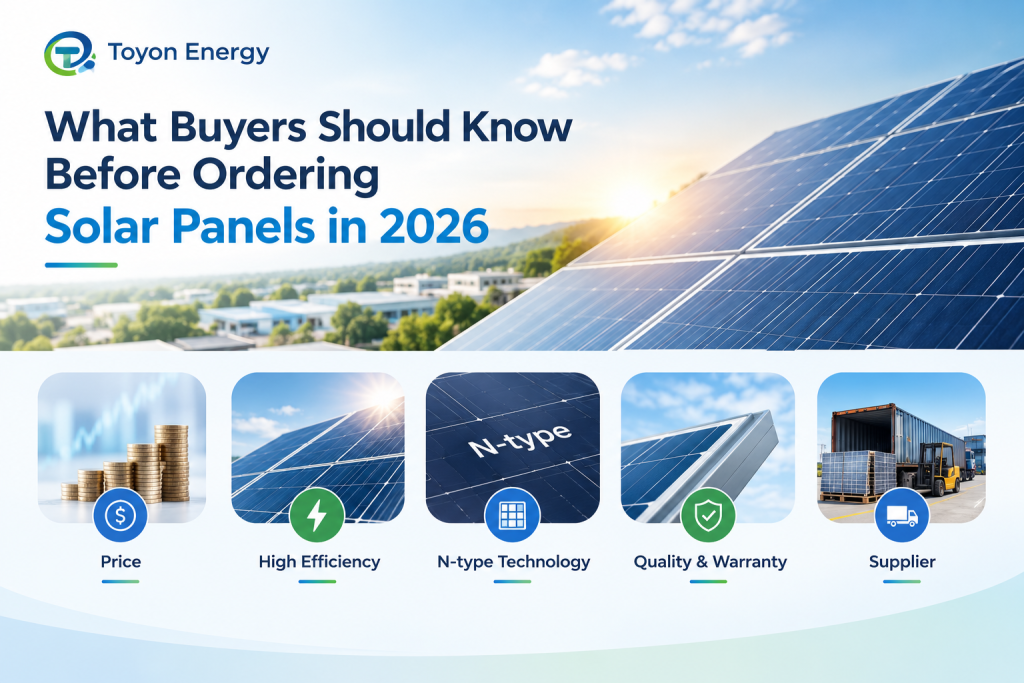
1. Compare Solar Panel Price Beyond Cost per Watt
Solar panel price remains an important factor, especially for commercial projects and bulk purchases. However, the lowest price per watt does not always mean the lowest overall project cost.
When requesting a quotation, buyers should compare module wattage, efficiency, technology, warranty, certifications, MOQ, shipping terms, and delivery time. For large orders, transportation and installation costs can also have a significant impact on the final project budget.
2. Are High Efficiency Solar Panels Worth It?
High efficiency solar panels can be particularly valuable for commercial rooftops, factories, warehouses, and other projects where installation space is limited.
Higher efficiency allows more power to be generated from the same roof area. However, efficiency should not be considered alone. Buyers should also check temperature coefficient, degradation rate, bifaciality, mechanical load, module size, and expected energy yield.
The right module is the one that provides the best balance between efficiency, cost, reliability, and project requirements.
3. Choose the Right Power and N-Type Technology
Solar panel power is another important factor when choosing modules in 2026. Higher-power modules, such as 500W, 550W, and 600W+ panels, can help reduce the number of modules, mounting structures, and installation work required for a project.

At the same time, buyers should pay attention to N-type solar panels, which have become increasingly popular for modern PV projects. Compared with traditional P-type modules, N-type technologies such as TOPCon can offer high efficiency, lower degradation, and good performance in demanding outdoor conditions.
However, higher wattage is not always better. Buyers should also check module size, weight, operating current and voltage, inverter compatibility, and installation requirements before ordering.
4. Check Solar Panel Quality Before Ordering
Before placing an order, buyers should look beyond the product price and carefully check the module's quality and specifications. Key factors include solar module efficiency, power tolerance, temperature coefficient, degradation rate, mechanical load, and product warranty.
For buyers planning a solar module wholesale order, it is also important to confirm the exact model, certifications, packaging, production lead time, and after-sales support. Checking these details before payment can help avoid specification mismatches, delivery delays, and unexpected costs.
5. Don't Focus Only on the Lowest Price
A solar module is expected to operate for decades, so long-term performance matters. Degradation rate, temperature performance, warranty coverage, and supplier reliability can all affect the actual return on investment.
For commercial and industrial projects, buyers should evaluate total project value, rather than comparing solar panel price alone.
خاتمة
Before ordering solar panels in 2026, buyers should compare price, efficiency, technology, quality, warranty, certifications, and supplier capability. Whether you need high efficiency solar panels for a commercial rooftop or solar module wholesale supply for distribution and EPC projects, choosing the right manufacturer can help reduce procurement risks and support long-term project performance.
Looking for reliable solar panels for your next project? Contact Toyon Energy for product specifications, bulk quotations, and project support.
الأسئلة الشائعة
1. Should I choose TOPCon, HJT, or another N-type technology?
The choice depends on project requirements, budget, climate, available space, and expected energy yield. Buyers should compare efficiency, degradation, temperature performance, warranty, and total project cost rather than choosing a technology based on its name alone.
2. Is a higher-wattage solar panel always better?
Not necessarily. Higher-wattage modules can reduce the number of panels needed, but their larger size or higher operating current may affect transportation, installation, mounting, or inverter compatibility. The best choice depends on the complete project design.
3. What should I check before ordering solar panels?
Buyers should check the exact module model, power output, efficiency, N-type technology, certifications, warranty, degradation rate, packaging, lead time, and supplier's after-sales support. For international orders, shipping terms and delivery schedules should also be confirmed in advance.
4. What solar panel wattage should I choose?
The right wattage depends on the project design, available space, inverter specifications, mounting system, and installation conditions. Higher-power modules can reduce the number of panels required, but buyers should also consider module size, weight, current, and voltage.
5. Why are N-type solar panels popular in 2026?
N-type solar panels, including TOPCon-based modules, are increasingly used because they can provide high efficiency, lower degradation, and strong long-term performance. They are suitable for many residential, commercial, and utility-scale PV applications.
6. Are high efficiency solar panels worth the higher cost?
High efficiency solar panels can be a good option for commercial rooftops, factories, and projects with limited installation space. However, buyers should also consider degradation, temperature performance, module size, and overall project economics before choosing a higher-priced module.