


Table of Contents
With rising electricity costs and increasing demand for clean energy, more factories and industrial facilities are investing in factory rooftop solar systems to reduce energy expenses and improve energy sustainability. However, choosing the right solar panels for industrial applications is a critical decision that directly affects system efficiency, long-term performance, and return on investment (ROI).
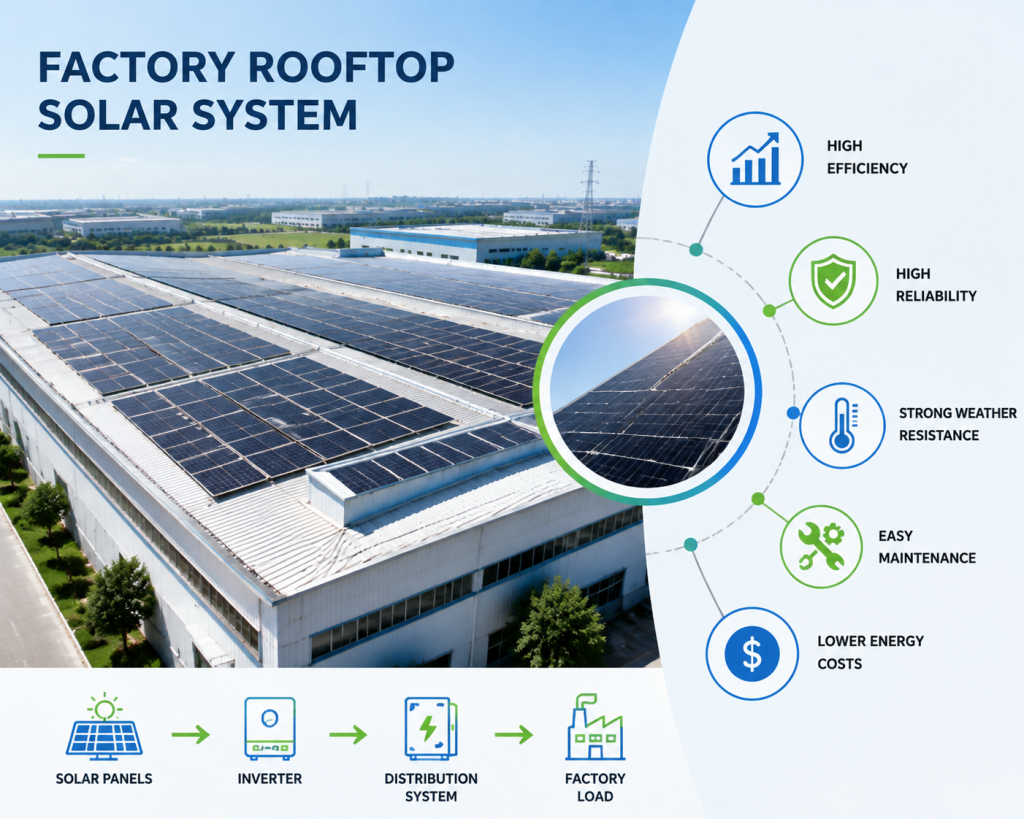
Unlike residential solar projects, industrial rooftop solar systems usually involve larger installation areas, higher energy consumption, and more demanding operating conditions. Therefore, businesses need to consider multiple factors before selecting the right industrial solar panels.
1. Evaluate Factory Energy Consumption and Solar System Requirements
The first step in selecting solar panels for a factory rooftop solar system is understanding your electricity demand.
Industrial facilities often operate with high power loads, including manufacturing equipment, production lines, HVAC systems, and lighting. Before choosing solar modules, businesses should analyze:
- Daily electricity consumption
- Peak power demand
- Available rooftop area
- Operating hours
- Future energy expansion plans
A proper energy assessment helps determine the required solar capacity and the most suitable solar panel system for industrial use.
For factories with high daytime electricity consumption, a well-designed rooftop solar system can maximize self-consumption and significantly reduce grid electricity costs.
2. Choose High-Efficiency Solar Panels for Limited Rooftop Space
Factory rooftops often have limited available space, making solar panel efficiency an important consideration.
High-efficiency monocrystalline solar panels can generate more electricity from the same rooftop area compared with traditional modules. For industrial projects, higher power output modules such as 580W, 600W, or 650W solar panels are increasingly preferred because they allow businesses to install larger capacity systems with fewer panels.
When evaluating solar panel efficiency, consider:
- Module conversion efficiency
- Power output per panel
- Energy yield under real operating conditions
- Long-term degradation rate
Selecting efficient solar modules can improve overall system performance and increase the lifetime value of a factory solar investment.
3. Consider Solar Panel Technology and Performance
Different solar panel technologies have different advantages for industrial applications.
Currently, many large-scale industrial solar projects use advanced technologies such as:
TOPCon Solar Panels
TOPCon technology provides higher efficiency, improved temperature performance, and lower degradation, making it suitable for commercial and industrial solar projects.
Bifacial Solar Panels
Bifacial modules can generate electricity from both front and rear sides, making them suitable for ground-mounted industrial projects or locations with high reflected light.
High-Power PV Modules
Large factories and industrial facilities often benefit from high-wattage solar panels because they can reduce installation costs, simplify system design, and improve project economics.
The right technology depends on project location, installation conditions, budget, and energy goals.
4. Check Durability and Warranty for Long-Term Operation
A factory rooftop solar system is a long-term investment, usually operating for more than 25 years. Therefore, durability and reliability are essential factors when selecting industrial solar panels.
Businesses should check:
- Product warranty
- Power output warranty
- Weather resistance
- Temperature coefficient
- Performance in harsh environments
For factories located in areas with high temperatures, humidity, dust, or strong sunlight, choosing reliable solar modules with excellent environmental adaptability can help maintain stable energy production.
5. Consider Solar Panels with Battery Storage Integration
Many industrial companies are now combining solar PV with battery energy storage systems (BESS) to improve energy management.
A solar + storage solution allows factories to:
- Store excess solar energy
- Reduce peak electricity costs
- Provide backup power during outages
- Improve energy independence
When selecting solar panels for industrial use, businesses should consider whether the PV system can integrate with future energy storage solutions.
A properly designed industrial solar energy system with battery storage provides greater flexibility and long-term energy savings.
6. Work with an Experienced Industrial Solar Solution Provider
Choosing the right solar panels is only one part of a successful factory rooftop solar project. System design, installation quality, energy analysis, and after-sales support are equally important.
An experienced solar energy provider can help businesses select suitable PV modules, design optimized rooftop layouts, and develop complete solutions based on actual energy requirements.
Conclusion
Selecting the right solar panels for factory rooftop solar systems requires careful evaluation of energy demand, rooftop conditions, panel efficiency, technology, durability, and future energy needs.
High-efficiency industrial solar panels combined with professional system design can help factories reduce electricity costs, improve energy reliability, and achieve long-term sustainability goals.
With advanced solar PV modules, energy storage solutions, and customized industrial solar systems, Toyon Energy provides reliable clean energy solutions for factories, commercial buildings, and large-scale industrial projects worldwide.
FAQs
1. What type of solar panels are best for factory rooftop solar systems?
The best solar panels for factory rooftop solar systems are usually high-efficiency monocrystalline solar panels, especially advanced technologies such as TOPCon and bifacial modules. These panels provide higher power output, better energy generation performance, and long-term reliability for large-scale industrial applications.
For factories with limited rooftop space, high-wattage solar panels can help maximize electricity production while reducing installation requirements.
2. How do I choose the right solar panel size for an industrial rooftop solar system?
The right solar panel size depends on several factors, including:
Factory electricity consumption
Available rooftop area
Local solar radiation conditions
Required solar capacity
Future energy demand
A professional solar provider can evaluate your energy usage and recommend the optimal PV system size for your factory.
3. Are high-efficiency solar panels better for industrial use?
Yes. High-efficiency solar panels are often more suitable for industrial projects because they generate more electricity from the same installation area.
For factories with limited roof space, higher-efficiency modules can:
Increase energy production
Improve rooftop utilization
Reduce the number of panels required
Improve project ROI
4. What is the difference between TOPCon and traditional solar panels for factory applications?
TOPCon solar panels offer higher efficiency, improved temperature performance, and lower power degradation compared with traditional PERC modules.
For industrial rooftop solar systems that require long-term stable operation, TOPCon technology can provide better energy yield and lifecycle value.
5. What factors should I consider when buying solar panels for a factory?
When selecting solar panels for industrial applications, businesses should consider:
Module efficiency
Power output
Solar panel technology
Warranty period
Temperature coefficient
Environmental durability
Manufacturer reliability
Long-term energy performance
The lowest upfront price is not always the best choice. Higher-quality solar modules can provide better long-term returns.
6. What is the ROI of installing solar panels on a factory roof?
The return on investment depends on:
Electricity prices
Solar system size
Installation cost
Solar generation capacity
Government incentives
Factories with high daytime electricity demand usually achieve faster payback because more solar power can be directly consumed instead of purchased from the grid.
7. Should factories choose rooftop solar or ground-mounted solar systems?
The choice depends on available space and project goals.
Factory rooftop solar systems are ideal when:
Large roof areas are available
Electricity demand is high during daytime
Businesses want to use existing space
Ground-mounted solar systems may be better when:
Land availability is sufficient
Larger solar capacity is required