


Table of Contents
BESS for supermarkets is worth considering when refrigeration, evening demand and power interruptions put pressure on the operating budget. Supermarkets in the Caribbean face distinct energy challenges. Refrigeration systems, freezers, air conditioning, lighting, and checkout equipment consume electricity throughout the day, while high electricity prices and grid interruptions can increase operating costs. For supermarkets that rely on diesel generators during outages, fuel and maintenance expenses add further pressure.
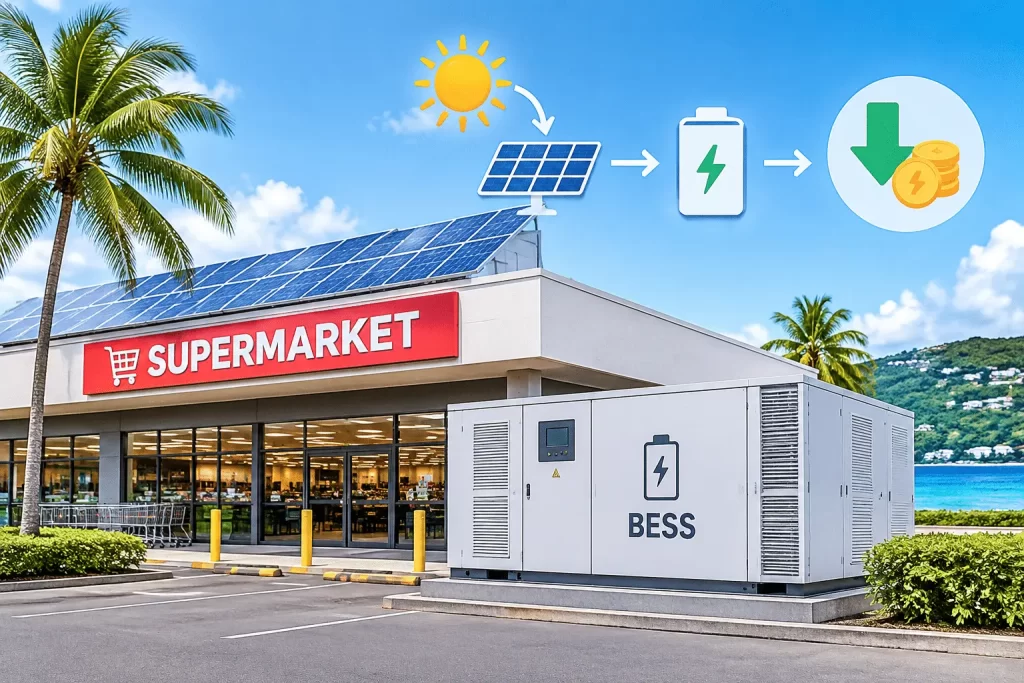
A commercial battery energy storage system (BESS) can help supermarkets manage electricity consumption, reduce peak demand, and improve energy reliability. When combined with solar power, battery storage can provide a practical solution for reducing long-term energy costs.
1. Why Do Caribbean Supermarkets Have High Electricity Costs?
Supermarkets require electricity throughout the day, and some equipment must operate continuously. Commercial refrigeration systems, freezers, HVAC units, display lighting, and cold storage facilities all contribute to substantial energy consumption.
Several factors can increase electricity expenses:
- Continuous refrigeration: Refrigerators and freezers operate around the clock to protect food quality.
- High air conditioning demand: Hot and humid Caribbean weather increases cooling requirements.
- Peak electricity demand: Running multiple refrigeration compressors and HVAC systems simultaneously can increase demand-related charges where applicable.
- Unstable power supply: Grid interruptions can disrupt operations and increase reliance on backup generators.
Installing a commercial battery energy storage system can help supermarkets manage these challenges more efficiently.
2. How BESS for Supermarkets Can Manage Energy Costs
A battery energy storage system helps supermarkets manage electricity demand, maximize solar energy use, and maintain reliable operations. For Caribbean supermarkets, four key strategies can help reduce energy costs and protect perishable inventory.
Peak Shaving
- Supermarkets can experience significant power spikes when energy-intensive equipment, such as refrigeration compressors and air conditioning units, operates simultaneously.
- Commercial electricity tariffs may include demand charges based on the highest power demand recorded during a billing period.
- A commercial BESS can automatically discharge stored energy during peak demand periods, flattening the load profile and potentially reducing demand charges.
Solar Self-Consumption and Load Shifting
- Caribbean locations offer strong solar energy potential, allowing rooftop and carport solar PV systems to generate electricity during daylight hours. At times, solar production may exceed a supermarket's immediate power demand.
- Instead of exporting surplus electricity at a low compensation rate, a solar battery storage system can store excess solar energy for later use.
- The stored energy can power lighting, refrigeration, and other equipment during the evening or night, increasing solar self-consumption and reducing grid electricity purchases.
Time-of-Use (TOU) Arbitrage
- Where utilities offer time-of-use (TOU) rates, electricity prices may vary depending on the time of day.
- A BESS can charge during lower-price periods and discharge when electricity rates rise, helping supermarkets optimize energy consumption and reduce electricity expenses.
- Actual savings depend on the local tariff structure, battery efficiency, and the difference between charging and discharging prices.
Cold-Chain Backup and Loss Prevention
- Unexpected grid outages and severe weather events can interrupt refrigeration, threaten food safety, and cause substantial losses of perishable inventory.
- A properly configured commercial battery energy storage system can provide backup power for designated critical loads, including refrigeration equipment, freezers, and point-of-sale systems.
- With compatible backup controls and sufficient battery capacity, a BESS can help maintain cold-chain continuity, reduce operational disruptions, and minimize spoilage risks.
3. How to Combine Solar PV and BESS for a Caribbean Supermarket
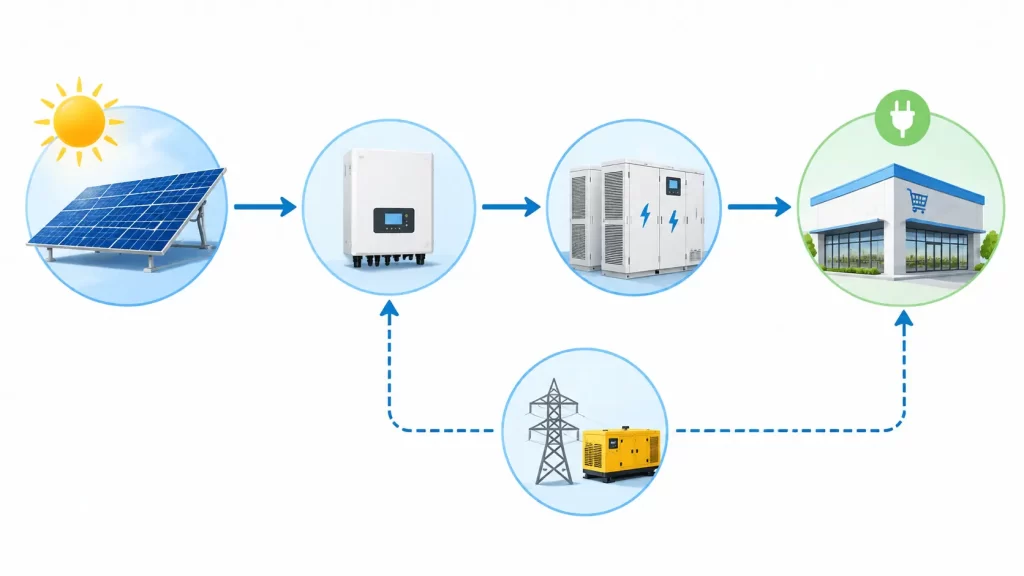
An integrated solar and battery storage system for supermarkets can combine rooftop photovoltaic panels, a battery energy storage system, hybrid or compatible power conversion equipment, an EMS, and grid or generator connections where required.
A suitable system should be designed around the supermarket's actual electricity consumption rather than floor area alone.
Before selecting equipment, businesses should evaluate:
- Daily and hourly electricity consumption
- Refrigeration and HVAC load profiles
- Peak demand and utility tariff structure
- Available rooftop or carport solar capacity
- Required battery backup duration
- Local temperature, humidity, and coastal corrosion conditions
For example, a supermarket with high daytime cooling loads may benefit from rooftop solar generation, while battery storage can help manage short periods of peak demand and support selected loads after sunset. The optimal battery size depends on the intended operating strategy and required discharge duration.
4. What Matters When Planning BESS for Supermarkets?
Choosing the right commercial battery energy storage system requires more than comparing battery prices.
First, assess usable battery capacity in kWh and power output in kW. Capacity determines how much energy can be stored, while power output determines how much load the system can support at a given moment.
Second, consider battery efficiency, cycle life, warranty, and the battery management system (BMS). An EMS should coordinate solar generation, battery charging and discharging, and electricity demand according to the project's objectives.
For Caribbean installations, equipment should also be suitable for high temperatures, humidity, and coastal environments. Appropriate enclosure protection, corrosion resistance, ventilation or thermal management, and qualified installation are important considerations.
Supermarkets requiring backup power should confirm which critical loads will be supported, whether islanded operation is available, and how the system will transition during grid outages. Standard grid-connected BESS equipment does not automatically provide backup power.
5. Is BESS a Cost-Effective Investment for Caribbean Supermarkets?
The financial benefits of supermarket energy storage depend on electricity prices, demand charges, solar generation, battery utilization, and installation costs.
Businesses should compare projected annual electricity savings with equipment, installation, maintenance, and replacement costs. A detailed feasibility study can estimate payback period and return on investment (ROI) under different operating scenarios.
For supermarkets planning to reduce electricity expenses, a properly sized BESS combined with commercial solar PV can offer a flexible approach to energy cost management and operational resilience.
Conclusion
Reducing electricity costs in Caribbean supermarkets requires a strategy that addresses refrigeration demand, air conditioning, peak loads, and renewable energy integration. A well-designed BESS for supermarkets can support peak shaving, increase solar self-consumption, and improve energy management when matched to local electricity tariffs and operating requirements.
Toyon Energy provides customized solar and energy storage solutions for commercial and industrial projects, helping businesses evaluate suitable system configurations for their energy needs.
FAQs
1. How Can BESS for Supermarkets Reduce Caribbean Electricity Bills?
BESS stores excess solar energy during the day and releases it when electricity demand increases or solar generation decreases. It can also reduce peak demand charges where the local electricity tariff supports peak shaving, helping supermarkets optimize energy costs.
2. Is Battery Storage Worth It for a Supermarket with High Refrigeration Loads?
Yes, it can be beneficial for supermarkets with significant refrigeration and cooling loads. Battery storage can support refrigeration systems during peak demand periods and provide backup power for selected critical equipment during grid outages.
3. How Do You Size a BESS for a Commercial Supermarket?
BESS sizing depends on the supermarket's hourly electricity consumption, peak demand, refrigeration loads, required backup duration, and solar generation capacity. Both battery power (kW) and storage capacity (kWh) should be considered.
4. Can a BESS Keep Supermarket Refrigerators Running During a Power Outage?
Yes. A properly designed battery energy storage system can provide backup power to selected refrigeration units, freezers, lighting, and other critical loads. The inverter capacity and battery capacity must match the required loads and backup duration.
5. Can Solar Panels and BESS Work Together to Reduce Peak Demand Charges?
Yes. Solar panels generate electricity during daylight hours, while BESS stores excess energy and discharges it when demand rises. This can help reduce grid power consumption during peak periods, depending on the local electricity tariff.
6. How Long Can a Commercial BESS Power a Supermarket During an Outage?
Backup duration depends on usable battery capacity and the total power consumption of the connected equipment. For example, an 800kWh usable battery can theoretically supply a continuous 200kW load for four hours, before accounting for conversion losses and operating reserves.
7. What Factors Should Be Considered When Installing BESS in the Caribbean?
For BESS for supermarkets in the Caribbean, assess the load profile, local tariff, usable energy, output power and priority backup loads. Site conditions also matter: temperature, humidity, coastal exposure, installation space and access for maintenance. Confirm that the proposed controls, protection and islanding arrangement support the intended operating modes; a grid-connected battery alone does not establish backup capability.