


Table des matières
Choosing the right grid-tied inverter is essential for the performance, reliability, and long-term value of a commercial solar project. For factories, warehouses, office buildings, and other commercial facilities, the inverter determines how efficiently solar electricity is converted into usable AC power and delivered to the building or electrical grid.
However, selecting an inverter involves more than comparing rated power or choosing the model with the highest efficiency. Businesses also need to consider system compatibility, peak generation, maintenance costs, grid requirements, and future expansion plans.
1. Match Inverter Capacity to Your Solar Array
The first step is to determine the appropriate inverter capacity for the planned solar array. The correct size depends on total PV capacity, expected generation, daytime electricity demand, roof orientation, and local grid connection requirements.
A commercial solar array does not always need an inverter with exactly the same rated capacity. Some systems use a higher DC solar array capacity than the inverter's rated AC output to improve utilization during periods of lower sunlight.
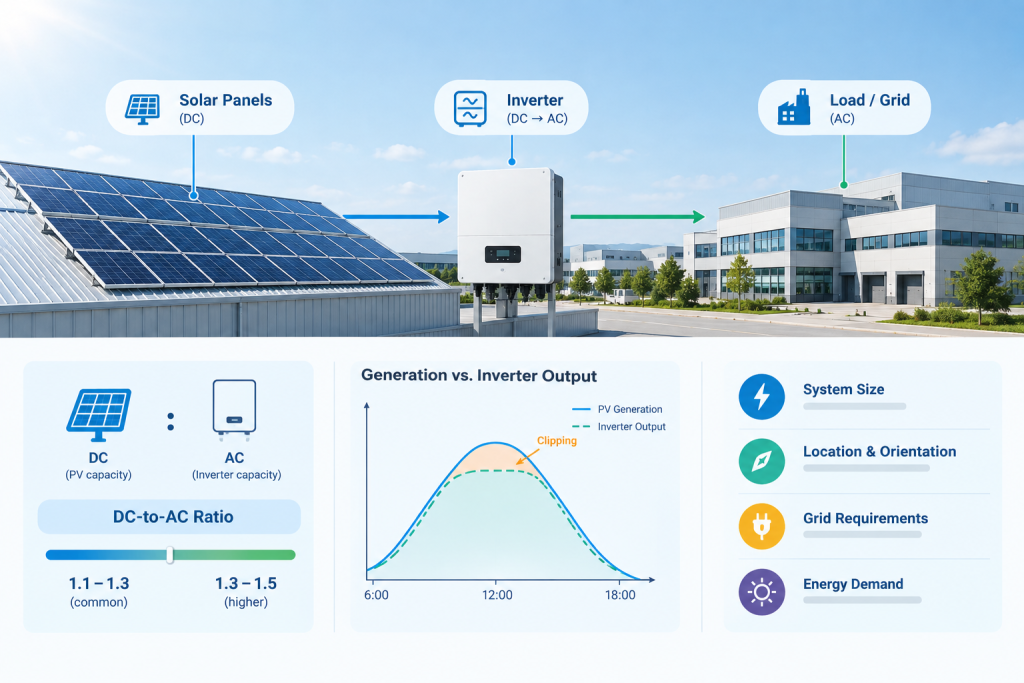
This relationship is known as the DC-to-AC ratio. A higher ratio can improve energy production during mornings and afternoons, but excessive oversizing may lead to clipping, when available solar power exceeds the inverter's output limit.
Before choosing a smaller inverter to reduce upfront costs, ask the supplier to provide estimated annual energy production and clipping losses. The best configuration should balance equipment costs with expected energy yield.
2. Check Voltage, Current, and MPPT Compatibility
Even an inverter with sufficient rated power may not be suitable if its electrical specifications do not match the solar panels.
Check the inverter's maximum DC input voltage, MPPT operating voltage range, maximum input current, and short-circuit current limits. These parameters must be compatible with the selected solar modules and string configuration under the project's expected operating conditions.
Maximum power point tracking (MPPT) helps the inverter extract available power from the PV array. Multiple MPPT channels can be useful when different roof sections have different orientations or shading conditions.
For commercial rooftops with complex layouts, confirm how the solar strings will be distributed across the inverter's MPPT inputs. Proper configuration can help avoid unnecessary generation losses.
3. Evaluate Three-Phase Output and Grid Compatibility
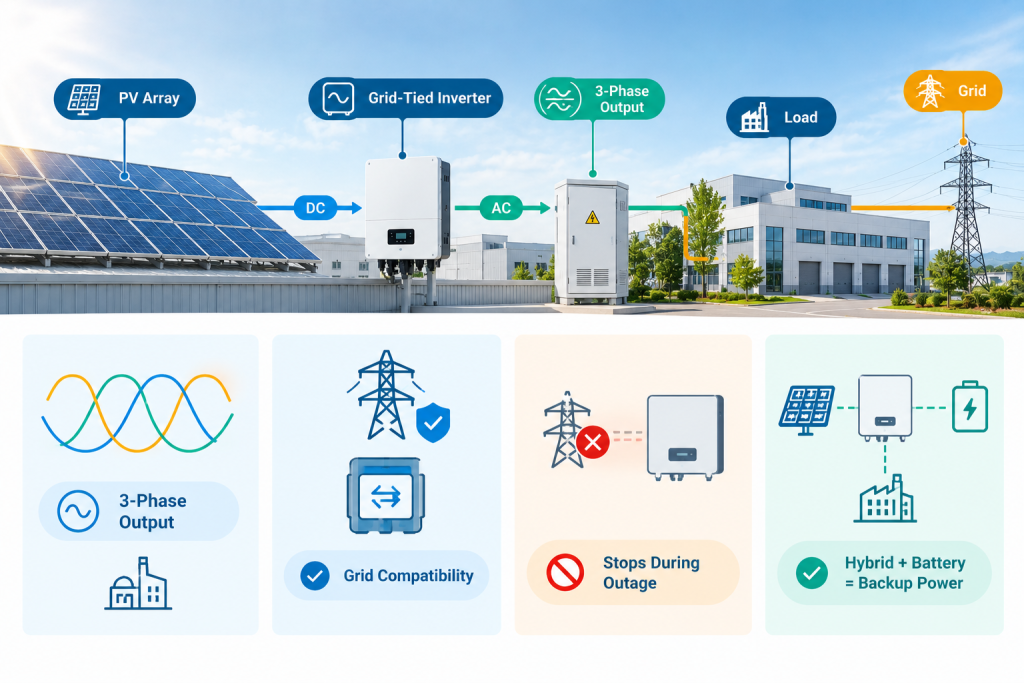
Commercial facilities commonly use three-phase electrical systems, so the inverter must match the site's electrical infrastructure and applicable grid connection requirements.
Before purchasing, confirm the required AC voltage, frequency, phase configuration, protection functions, and grid compliance certifications. Export limits and utility approval requirements should also be considered when the project is connected to a restricted grid connection point.
Businesses should not assume that every grid-tied inverter can supply electricity during a power outage. Standard grid-connected inverters normally shut down when the grid fails to prevent unsafe backfeeding. If backup power is required, a suitable hybrid inverter, battery system, and compatible backup configuration may be necessary.
4. Prioritize Reliability, Warranty, and Maintenance
An inverter is a long-term investment, and its replacement can involve both equipment costs and installation labor. A low purchase price may not represent the lowest lifetime cost if the equipment is difficult to service or replacement parts are unavailable.
Compare the warranty period, warranty conditions, local technical support, monitoring functions, and availability of spare parts. Ask who will handle troubleshooting and warranty claims if the original installer is no longer available.
Remote monitoring is particularly valuable for commercial projects because it helps operators identify abnormal generation, inverter faults, and unexpected shutdowns before they cause prolonged performance losses.
Also consider the installation environment. High temperatures, dust, humidity, and poor ventilation can affect equipment operation. Select an inverter with an appropriate environmental rating and follow the manufacturer's installation and maintenance requirements.
5. Consider Future Expansion and Energy Storage
A commercial facility's energy requirements may change as production increases, new equipment is installed, or electric vehicle charging is introduced. If expansion is possible, evaluate whether the proposed inverter arrangement can accommodate additional PV capacity or integrate with a future battery energy storage system.
Not every grid-tied inverter supports battery connection directly. Adding storage may require AC coupling, compatible hybrid equipment, additional controls, or modifications to the existing electrical system.
Discuss these possibilities with the system designer before finalizing the purchase. Planning ahead can reduce the risk of expensive retrofits.
Final Checklist Before Buying
Before selecting a grid-tied inverter for a commercial project, confirm:
- The inverter capacity and DC-to-AC ratio are supported by the system design.
- PV voltage, current, string configuration, and MPPT requirements are compatible.
- Three-phase output and grid compliance requirements are satisfied.
- Warranty coverage, technical support, and spare parts are available.
- Monitoring, maintenance, and future expansion requirements are addressed.
The right grid-tied inverter should deliver reliable performance, work safely with the site's electrical system, and support the project's long-term operating needs. By evaluating technical compatibility, expected energy yield, and lifetime service costs together, businesses can make a more informed commercial solar investment.
Looking for a suitable inverter for your commercial solar project? Explore Toyon Energy's solar solutions to discuss your project requirements and equipment compatibility.
FAQ
1. What Size Grid-Tied Inverter Does a Commercial Solar System Need?
The required inverter size depends on the total PV array capacity, DC-to-AC ratio, expected energy generation, and site-specific grid requirements. Ask your supplier to estimate annual energy yield and clipping losses before finalizing the inverter capacity.
2. What Happens If a Commercial Grid-Tied Inverter Fails?
The PV array connected to the failed inverter may stop delivering power, reducing the system's energy output. For larger installations, using multiple appropriately sized string inverters can limit the generation affected by a single inverter failure, although the best design depends on system architecture and cost.
3. Does a Longer Inverter Warranty Always Mean Better Reliability?
No. A longer warranty is valuable only when its coverage and service conditions are clear. Check whether replacement parts, labor, shipping, and on-site service are included, and confirm how warranty claims are handled if the original installer is no longer available.
4. Can a Grid-Tied Inverter Supply Power During a Grid Outage?
Standard grid-tied inverters generally shut down during a grid outage for anti-islanding protection. To maintain power to selected loads, a system typically needs compatible battery storage, suitable inverter functionality, and a properly designed backup circuit.
5. Should a Commercial Solar Project Use One Large Inverter or Multiple String Inverters?
One large inverter may simplify equipment management, while multiple string inverters can distribute generation across several units and reduce the impact of a single-unit failure. Compare installation costs, monitoring requirements, maintenance access, and system availability before deciding.
6. Can I Add Battery Storage to an Existing Grid-Tied Inverter?
It depends on the inverter model and system design. Some projects can add batteries through AC coupling, while others may require a compatible hybrid inverter or additional control equipment. Confirm communication protocols, operating modes, and backup functionality before purchasing.