


Table des matières
For businesses considering solar, the most important question is often simple: Will the system save enough money to justify the investment? Understanding the commercial solar ROI calculation can help business owners, facility managers and project developers compare different system options based on actual energy costs rather than focusing only on the upfront price.
1. Start With the Total Solar Investment
The first step is to determine the complete project cost. A système solaire commercial may include PV modules, inverters, mounting structures, electrical equipment, installation, engineering, permitting and other project costs. If battery storage is included, the energy storage system and related equipment should also be included in the investment calculation.
Do not evaluate a quote based only on the price per watt. A lower initial price does not necessarily mean better financial performance if the system produces less usable energy or requires higher long-term maintenance.
2. Calculate Annual Energy Savings
The next step is to estimate how much electricity the solar system can offset each year.
A simple calculation is:
Annual Solar Savings = Solar Energy Used × Electricity Rate
However, commercial projects are more complicated because electricity bills can include both energy charges and demand charges. A PV system can reduce energy purchased from the grid, but its impact on peak demand depends on when the facility reaches its highest load.
This is why an accurate commercial solar payback period should be based on the building's actual load profile rather than annual electricity consumption alone.
3. Consider Self-Consumption and Excess Solar
Not every kilowatt-hour generated by a commercial solar system has the same financial value. The actual savings depend largely on how much solar power a business can use directly during operating hours.
For example, a factory running production lines mainly during the day may have a high daytime electricity demand, allowing most of the solar generation to be consumed on-site. This can help reduce electricity purchases from the grid and improve the overall value of the PV system. In contrast, a warehouse, office building or facility with lower daytime consumption may have more excess solar generation, especially during weekends or periods of low activity.
When evaluating a C&I solar project, it is important to compare the solar generation profile with the facility’s actual load profile. Hourly or interval electricity data can help determine the appropriate PV capacity and estimate the expected self-consumption ratio. Simply installing the largest possible system may not always provide the best financial result if a significant amount of electricity has limited value after exceeding on-site demand.
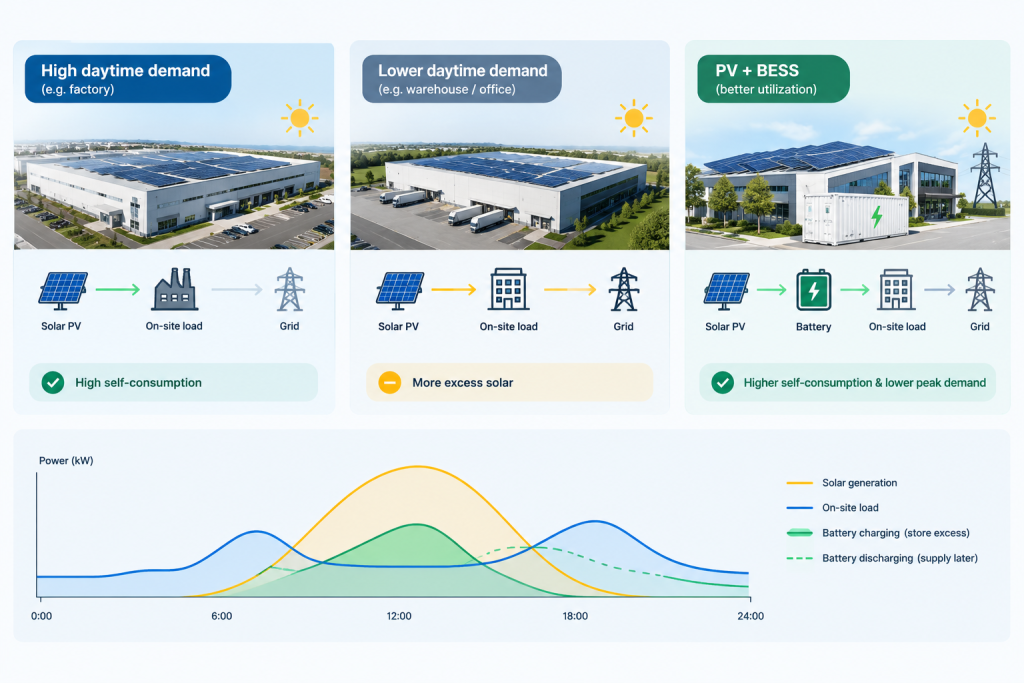
For projects with substantial excess solar generation, adding BESS can be considered to store surplus daytime energy and use it later when electricity demand is higher. A properly designed C&I PV + BESS solution can therefore improve solar utilization while also helping businesses manage peak demand and time-of-use electricity costs.
4. Where Does Battery Storage Fit?
Battery storage can change the economics of a commercial solar project. A BESS can store excess solar energy and discharge it when electricity prices are higher or when the facility needs to reduce peak demand.
However, adding a battery does not automatically improve ROI. The financial value depends on factors such as demand charges, time-of-use electricity rates, battery cost, usable capacity, efficiency and operating strategy. In some commercial applications, peak shaving can provide an additional source of savings beyond solar energy production.
Therefore, businesses should compare PV-only and PV + BESS scenarios instead of assuming that more equipment always means better returns.
5. Calculate the Payback Period
As a business owner, one of the first questions we ask is: How long will it take for the solar investment to pay for itself?
A simple way to estimate this is:
Payback Period = Net Project Cost ÷ Annual Financial Savings
For example, if we invest $300,000 in a commercial solar system and expect to save around $50,000 per year on electricity costs, the simple payback period would be about 6 years.
However, we would not make a purchasing decision based on payback alone. Before investing, we also need to consider electricity price changes, maintenance costs, financing expenses, system degradation and how our electricity consumption may change over time.
From a business perspective, the goal is not simply to achieve a short payback period. We want a solar system that can reduce operating costs, provide predictable energy savings and deliver stable financial value throughout its operating life.
6. Look Beyond the Initial ROI
For commercial businesses, solar investment should be evaluated beyond the initial payback period. A practical C&I solar ROI analysis should consider long-term electricity savings, system performance, maintenance costs, financing options and potential changes in energy prices.
The right solution also depends on the facility itself. A factory with high daytime electricity demand may benefit from a larger PV system, while a warehouse with lower daytime consumption may require a different system design. Available roof space, load profile, electricity tariffs and future energy demand should all be considered before determining the appropriate system size.
For businesses looking to reduce operating costs, a well-designed commercial solar solution can provide more predictable energy expenses over the long term. Depending on the project, combining PV, BESS and energy management can further improve energy utilization and help businesses manage peak demand and time-of-use electricity costs.
Foire aux questions
1. How long does it take for a commercial solar system to pay for itself?
The payback period depends on system cost, electricity prices, annual solar generation, self-consumption, financing and local incentives. A more accurate estimate should be based on the facility’s actual electricity usage rather than a general industry average.
2. How much can a business actually save with commercial solar?
The savings depend on how much electricity the business uses, when that electricity is consumed, and how solar generation is compensated. Businesses with high daytime electricity demand can often use more solar directly and reduce their grid electricity purchases.
3. Is a larger commercial solar system always better?
Not necessarily. If a system generates significantly more electricity than the facility can use during the day, more energy may be exported to the grid at a different compensation rate. The optimal system size should be based on the facility’s load profile, available roof space, electricity tariff and expected self-consumption.
4. How does self-consumption affect commercial solar ROI?
Self-consumed solar can directly replace electricity that would otherwise be purchased from the grid. Therefore, the percentage of solar energy used on-site can have a major impact on project savings and overall ROI.
5. What happens if a business produces more solar power than it uses?
Excess solar may be exported to the grid, stored in a battery, or curtailed, depending on the local grid rules and system configuration. The financial value of exported electricity should be included when calculating the project’s expected ROI.
6. Does a commercial solar system need battery storage?
Not every project needs BESS. A factory with strong daytime demand may already consume most of its solar generation directly. Battery storage becomes more relevant when there is significant excess solar, high peak demand, time-of-use pricing, or substantial electricity consumption after solar production hours.
7. How should a commercial solar system be sized?
System sizing should consider annual electricity consumption, hourly or interval load data, daytime demand, roof area, electricity tariffs, grid-export rules and future energy demand. Using actual load data generally provides a more useful basis for system design than simply sizing the system around annual consumption.
8. Do electricity demand charges affect commercial solar ROI?
They can. Some commercial electricity tariffs include charges based on peak power demand rather than only total energy consumption. In these cases, PV and BESS can be evaluated not only for reducing kWh consumption, but also for managing peak demand.
9. Should a business calculate ROI based on its current electricity bill?
The current electricity bill is an important starting point, but it should not be the only input. A proper analysis should also consider the facility’s load profile, electricity tariff structure, expected solar production, system degradation, maintenance, financing and potential changes in energy prices.