


Índice de contenidos
When choosing lithium ion batteries, many users focus only on the Ah rating without considering their actual power requirements. In reality, battery capacity and power are related but not the same. The Ah rating indicates how much energy a battery can store, while the available power depends on factors such as voltage, current, and the battery’s discharge capability.
So, should you choose a 100Ah or 200Ah battery? The right choice depends mainly on how much electricity your equipment uses and how long you need it to run.
¿Cuál es la diferencia entre 100Ah y 200Ah?
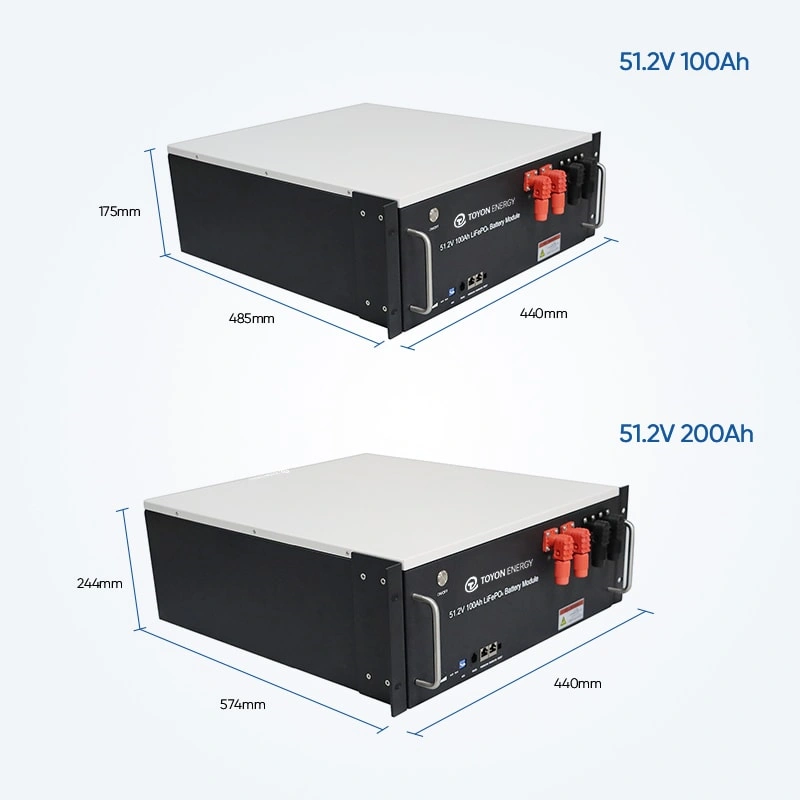
At the same voltage, a 200Ah battery provides approximately twice the energy capacity of a 100Ah battery. For example, a 12V 100Ah battery has a theoretical capacity of about 1.2kWh, while a 12V 200Ah battery provides about 2.4kWh.
For applications with relatively low energy consumption, such as lighting, small RVs, monitoring systems, or backup equipment, 100Ah lithium ion batteries may provide enough capacity without adding unnecessary cost or weight.
A 200Ah battery is more suitable when several devices need to operate at the same time or when longer backup power is required.
¿Cómo se calcula la capacidad correcta de la batería?
Before choosing a battery, estimate how much energy your equipment consumes each day.
For example, if a 100W device operates for five hours per day, it consumes approximately 500Wh. If you also use a refrigerator, lights, water pump, or other equipment, their energy consumption should be added to the total.
If your daily energy requirement is around 1kWh, a 100Ah battery may be sufficient depending on the system voltage and operating conditions. If your consumption is closer to 2kWh or higher, a 200Ah battery can provide more practical capacity and longer runtime.
Keep in mind that the actual usable capacity can be affected by factors such as inverter efficiency, operating temperature, discharge rate, and the battery management system. It is therefore better to leave some capacity as a safety margin rather than sizing the battery exactly to your calculated consumption.
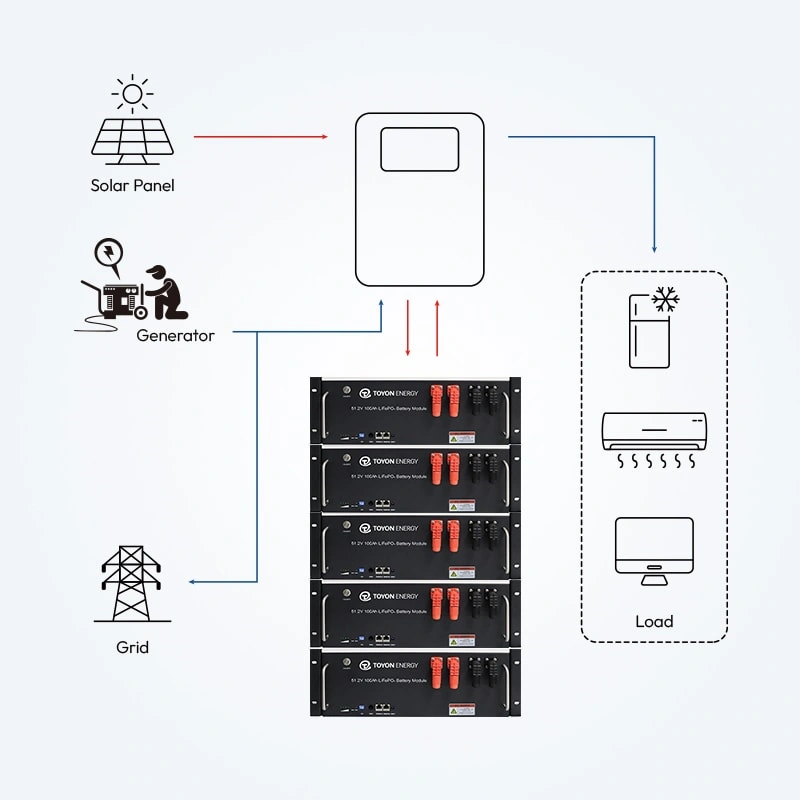
¿Cuándo debe elegir una batería de 200Ah?
If longer runtime is more important than minimizing the initial purchase cost, high-capacity lithium ion batteries can be a better choice.
A 200Ah battery may be particularly useful for:
- RVs and boats requiring extended off-grid power
- Backup power systems
- Applications with multiple electrical devices
- Equipment that operates for long periods
- Systems where charging opportunities are limited
- Users planning to add more electrical loads in the future
However, bigger does not always mean better. If your daily electricity consumption is relatively low, choosing a 200Ah battery may add unnecessary cost, size, and installation requirements.
100 Ah o 200 Ah: ¿Cuál es la adecuada para ti?
In general, standard lithium ion batteries with a 100Ah capacity can be a practical option for users with moderate energy requirements, limited installation space, or a tighter budget. A 200Ah battery is better suited to applications that require longer runtime, higher energy storage, or multiple devices operating throughout the day.
Instead of choosing a battery based only on the Ah rating, consider your equipment’s power consumption, operating hours, system voltage, available installation space, and expected future demand.
The best battery is not necessarily the largest one—it is the one that provides enough usable energy and power for your specific application without unnecessary capacity or cost.
Preguntas frecuentes
1. ¿Es suficiente una batería de iones de litio de 100 Ah para el uso diario?
Una batería de 100Ah puede ser suficiente para aplicaciones con un consumo de energía moderado, como iluminación, pequeños electrodomésticos, equipos de monitoreo o necesidades básicas de energía en vehículos recreativos. El tiempo de funcionamiento real depende del voltaje de la batería, la carga conectada y el tiempo que funcione el equipo.
2. ¿Es una batería de iones de litio de 200Ah mejor que una de 100Ah?
No necesariamente. Una batería de 200 Ah almacena aproximadamente el doble de energía que una de 100 Ah a la misma tensión, pero puede no ser necesaria para aplicaciones con bajo consumo de energía. La mejor opción depende de tus necesidades energéticas diarias, el espacio disponible y el presupuesto.
3. ¿Cuánto tiempo puede una batería de iones de litio de 100Ah hacer funcionar un dispositivo de 100W?
Una batería de 100Ah puede proporcionar teóricamente alrededor de 1,2kWh cuando funciona a 12V. Por lo tanto, un dispositivo de 100W podría funcionar durante varias horas, aunque el tiempo de funcionamiento real será menor debido a factores como la eficiencia del inversor, las características de descarga de la batería y otras pérdidas del sistema.
4. ¿Puedo usar una batería de 200Ah en lugar de una de 100Ah?
Sí, siempre y cuando el voltaje de la batería, el sistema de carga, el inversor, el sistema de gestión de baterías y los requisitos de instalación física sean compatibles. Una batería de mayor capacidad puede proporcionar un mayor tiempo de funcionamiento, pero se debe revisar todo el sistema eléctrico antes de realizar el cambio.
5. ¿Son mejores las baterías de 100Ah o de 200Ah para las autocaravanas?
Ambas pueden funcionar bien para aplicaciones en vehículos recreativos (RV). Una batería de 100Ah puede ser adecuada para iluminación básica, dispositivos electrónicos y pequeños electrodomésticos, mientras que una batería de 200Ah suele ser más adecuada para viajes más largos fuera de la red o para RVs con refrigeradores, inversores, bombas de agua y otras cargas más grandes.
6. ¿Debería elegir una batería más grande para futuras necesidades energéticas?
If you expect your energy consumption to increase, choosing a larger battery can provide additional capacity and reduce the need for an upgrade later. However, the battery should still be appropriately matched to the charging system, inverter, installation space, and expected load.