


If you are looking into containerized solar battery storage for a factory, warehouse or cold-storage facility, you probably have a practical concern in mind. Your panels generate well at midday, but the evening shift still draws electricity from the grid. Or a power cut could interrupt refrigeration, and you want to understand what a battery could actually keep running.
Before getting caught up in equipment sizes, it helps to follow the energy through a normal working day. That is where storage starts to make sense.
المحتويات
What Is Containerized Solar Battery Storage?
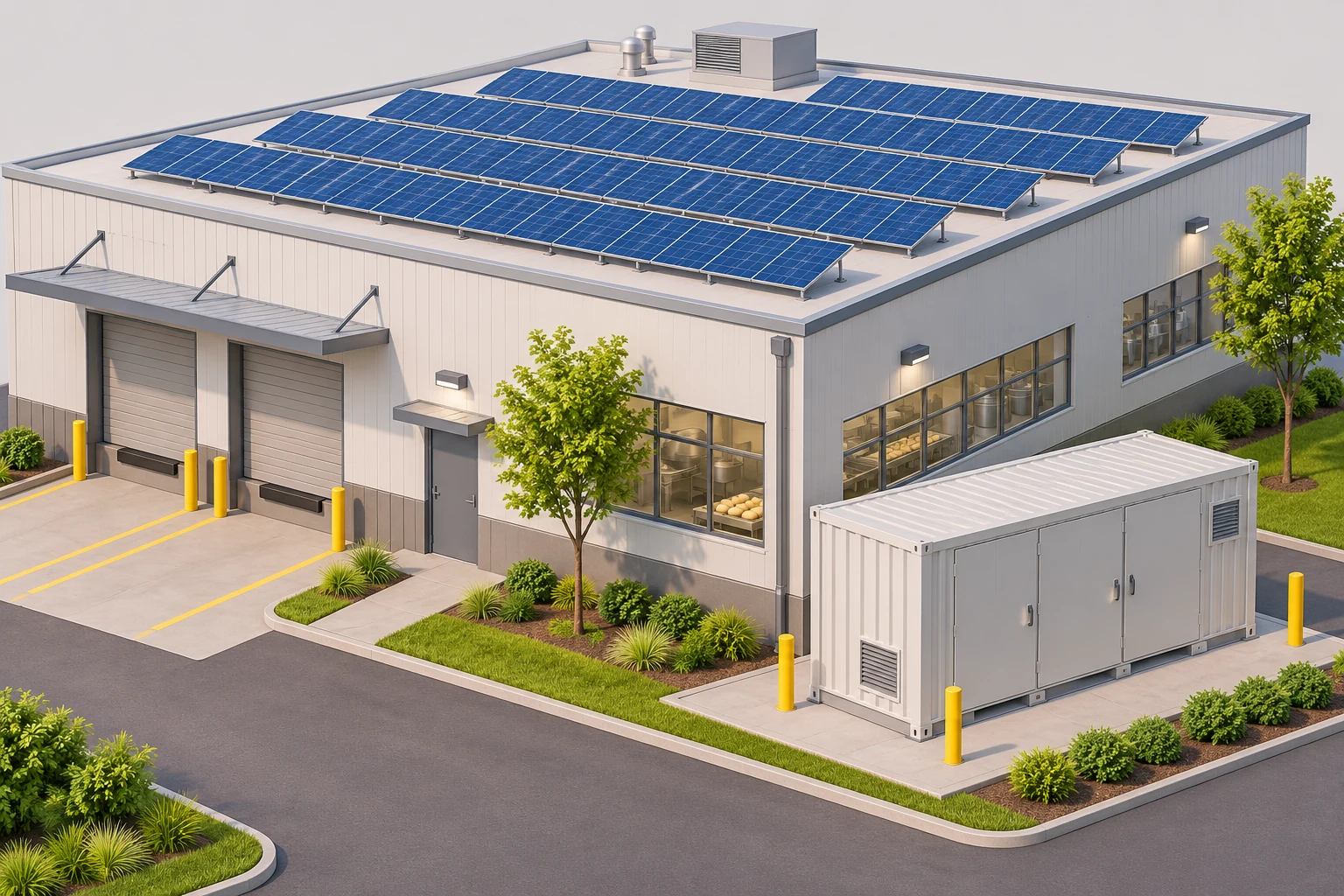
Containerized solar battery storage brings batteries and supporting equipment into an enclosure that can be transported to the project site. It connects to the facility's solar and electrical systems so energy can be stored and used later.
Inside, the battery management system (BMS) monitors battery conditions and manages protective functions. The power conversion system (PCS) handles conversion between the battery's DC electricity and the site's AC network. The energy management system (EMS) coordinates when the battery charges and discharges.
Cooling and protection equipment support operation within the system's design limits. Some configurations include the PCS inside the container; others place it separately. What matters for your facility is how those parts work together with the existing installation.
How Could It Help With the Evening Shift?
Imagine a food-processing facility where production slows around midday, while refrigeration and cleaning continue later. On a sunny day, solar output may exceed the site's immediate demand. Without storage, that surplus might be exported or curtailed, depending on the connection arrangement.
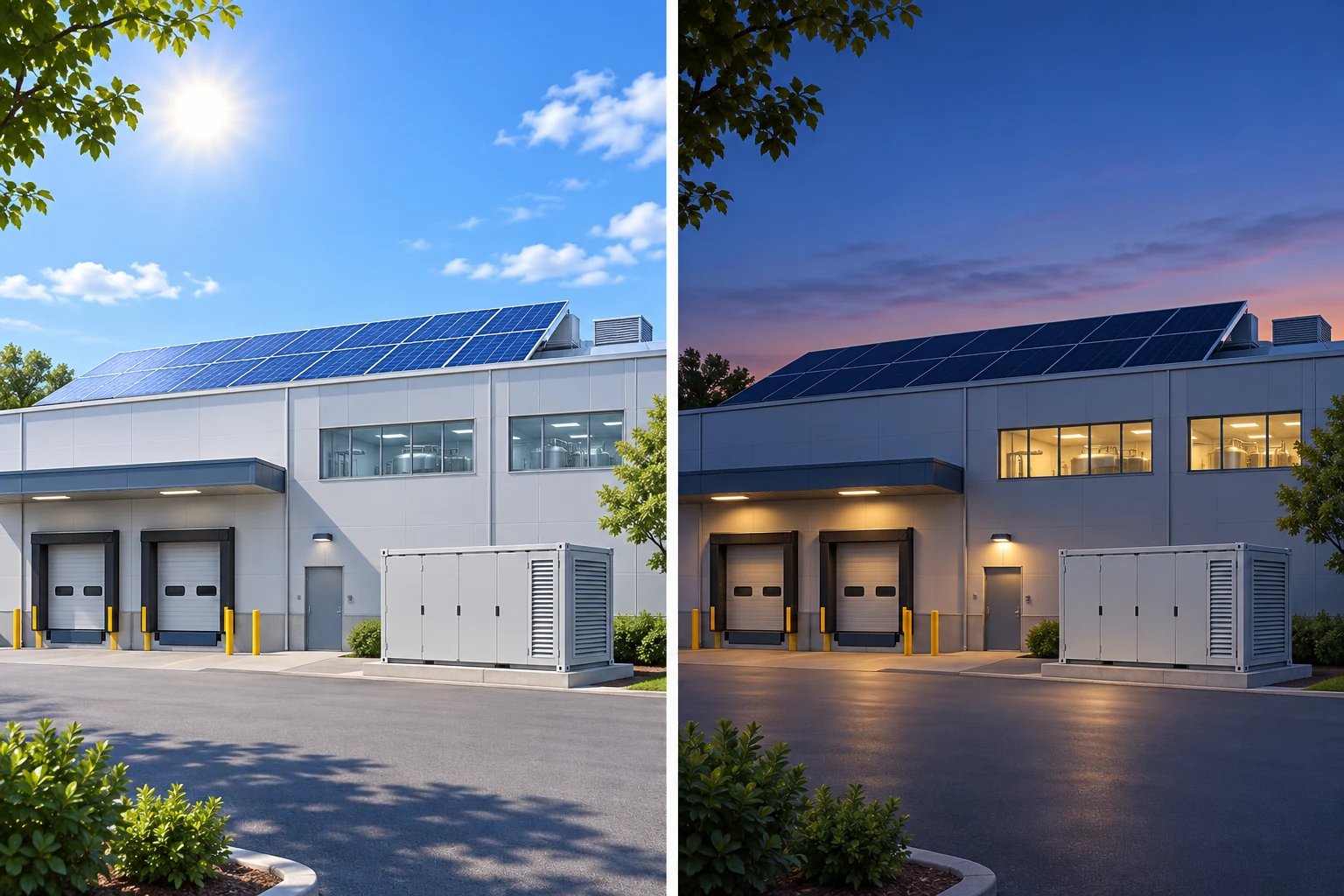
Containerized solar battery storage can hold some of that energy for later. When solar output falls, it can discharge to support the remaining load. This helps move some of the daytime solar energy into the hours when the facility still needs it.
The important question is whether your site actually has energy available to store. If production already uses nearly all the daytime solar output, the battery will need a different charging plan. Grid charging may be an option where permitted, with its value depending on the tariff and operating strategy.
Looking at weekdays, weekends and seasonal changes helps reveal that picture. A single sunny afternoon tells you very little about the rest of the year.
How Does Storage Help With Demand Peaks?
Sometimes the problem is a brief period when several large loads run together. The battery can discharge during that period to reduce the power drawn from the grid, a strategy known as peak shaving.
Whether this reduces your bill depends on how demand is measured and charged, how long the peak lasts and whether the battery has energy available then. It is worth separating this question from solar self-consumption: using more of your own solar and managing a demand charge are related opportunities, but they need different operating decisions.
What Happens If the Power Goes Out?
For a cold-storage operator, this is often the question that matters most. Keeping selected refrigeration circuits and controls running may be more important than supporting every piece of equipment on site.
That concern deserves a clear answer. If a compressor stops, the team needs to know what happens next: which loads remain supplied, whether a restart is possible and how much energy is left. Defining those priorities gives the backup design a clear purpose.
Backup requires a system designed to separate from the grid and establish a stable local supply. Having solar panels and a battery does not automatically provide that capability. Switching, protection and inverter controls must work together.
Motor starting demands also need attention. Knowing which equipment must run, and how it starts, makes the backup requirement clearer than beginning with a battery capacity figure.
How Much Battery Capacity Would You Need?
من أجل commercial battery storage, power and energy describe different things. Power, measured in kW or MW, tells you the rate of electricity delivery. Energy, measured in kWh or MWh, tells you the amount stored.
For example, one containerized battery energy storage system configuration pairs 2.17 MWh of battery energy with a 1 MW PCS. Those two ratings help describe the equipment, but they do not establish a fixed backup duration for your facility.
Actual runtime depends on the load, usable energy, reserve settings, losses and operating conditions. There is also a practical trade-off: energy held for an unexpected outage is unavailable for everyday dispatch while that reserve is maintained.
How Would It Fit Your Existing Solar System?
Storage can be added through an AC-coupled arrangement, where the PV inverter and battery PCS connect through the site's AC network, subject to compatibility. DC-coupled designs connect storage on the DC side of the conversion system.
For containerized solar battery storage, the connection design, control compatibility, maintenance space and delivery access all shape what is practical. Start with your facility's working pattern and the equipment you need to protect. The clearer those needs become, the easier it is to see where storage would make a useful difference.
الأسئلة الشائعة
Can containerized solar battery storage be added to an existing commercial solar system?
Yes, it may be possible. An AC-coupled arrangement can provide a way to add storage, subject to compatibility. The existing inverter, electrical connection, protection and controls need to work with the proposed battery system.
Will the battery keep my whole facility running during a power cut?
That depends on the backup design and the loads it is intended to serve. Some facilities prioritise refrigeration, controls or other essential equipment. The system needs suitable islanding, switching and protection arrangements to support those loads.
How long will the stored energy last?
There is no single runtime for every site. It depends on usable battery energy, the equipment running, reserve settings, losses and operating conditions. Start with the loads you need to support and how long you need them to operate.
Can the same system handle peak shaving and backup?
A suitable system can be configured for both. The operating strategy needs to protect the chosen backup reserve while managing everyday demand. Keeping more energy available for an outage leaves less available for routine dispatch.