


المحتويات
For many businesses, installing solar panels on a commercial building is no longer just about generating renewable electricity. The bigger question is how to use that electricity efficiently throughout the day and whether battery storage should be part of the system.
A commercial rooftop solar system can be a practical choice when a facility has sufficient roof space and consumes a large amount of electricity during daylight hours. However, businesses with high evening consumption, demand peaks or backup requirements may benefit from adding battery energy storage.
So, which configuration makes more sense: rooftop solar only or PV + BESS?
Commercial Rooftop Solar vs PV + BESS
| Key Factor | Commercial Rooftop Solar | Commercial PV + BESS |
|---|---|---|
| Solar Generation | Generates electricity during daylight hours | Generates and stores solar electricity |
| Daytime Energy Use | Well suited to facilities with high daytime loads | Can directly supply daytime loads and charge the battery |
| Evening Energy Use | Requires grid electricity after solar production drops | Stored energy can be used during evening or low-solar periods |
| Peak Demand Management | Limited | Supports peak shaving and load management |
| Excess Solar | May be exported to the grid or curtailed | Excess solar can be stored for later use |
| طاقة احتياطية | Usually requires additional backup equipment | Can provide backup power for selected critical loads |
| System Complexity | Simpler system architecture | More components and energy management functions |
| Initial Investment | Generally lower | Generally higher due to battery storage |
| Future Flexibility | Can be designed for future BESS integration | Provides integrated solar and storage from the beginning |
| Suitable Applications | Warehouses, factories and commercial buildings with strong daytime demand | C&I projects with peak loads, evening demand, backup or energy-shifting needs |
When Commercial Rooftop Solar May Be Enough
A solar-only system can work well when the building's electricity demand closely matches its solar generation profile.
For example, factories, warehouses and commercial buildings that operate mainly during daytime hours can use a significant portion of the solar power directly. This reduces the amount of electricity purchased from the grid while making good use of available rooftop space.
Before choosing this configuration, businesses should look at their actual electricity consumption rather than simply estimating system size from roof area. Important factors include daytime load, operating hours, seasonal changes and available roof space.
If most electricity is consumed while the sun is available, adding batteries may not always provide enough additional value to justify the extra equipment and installation cost.
When PV + BESS Makes More Sense
A commercial solar battery storage system becomes more useful when the timing of electricity consumption does not match solar production.
Solar generation normally peaks during the middle of the day, while some businesses experience higher electricity demand later in the afternoon or evening. A battery can store excess solar energy and discharge it when solar production decreases.
Battery storage can also support peak shaving. If a facility has short periods of high power demand, the BESS can be configured to reduce grid demand during selected periods. This can be particularly relevant in markets where electricity bills are affected by demand charges.
Another important application is backup power. Businesses do not necessarily need to keep every electrical load running during a grid outage. Instead, the system can be designed around critical loads such as communication equipment, refrigeration, production equipment or essential lighting.
What Should You Check Before Adding BESS?
The right configuration should start with data.
Businesses should review their load profile, peak demand, electricity tariff, PV generation and expected battery operating schedule. Battery capacity should not simply be selected based on the size of the solar array.
For example, a facility with a large rooftop PV system but very low evening consumption may have limited use for a large battery. On the other hand, a facility with substantial late-day demand or frequent peak loads may have stronger reasons to consider storage.
Grid export limits should also be checked. If the local grid connection restricts how much solar electricity can be exported, battery storage may provide another way to use excess generation on site.
Think About Future Expansion
Energy requirements can change as a business grows. New production equipment, longer operating hours, EV charging or additional facilities can increase electricity demand.
For this reason, a C&I PV + BESS solution can provide greater flexibility when the project is expected to expand. The initial system can be designed with future battery capacity, inverter requirements and electrical infrastructure in mind.
However, flexibility does not mean every project needs a battery from day one. A well-designed solar-only system can also be prepared for future BESS integration if the electrical architecture and installation space are planned properly.
Solar Only or PV + BESS?
There is no universal configuration for every commercial project.
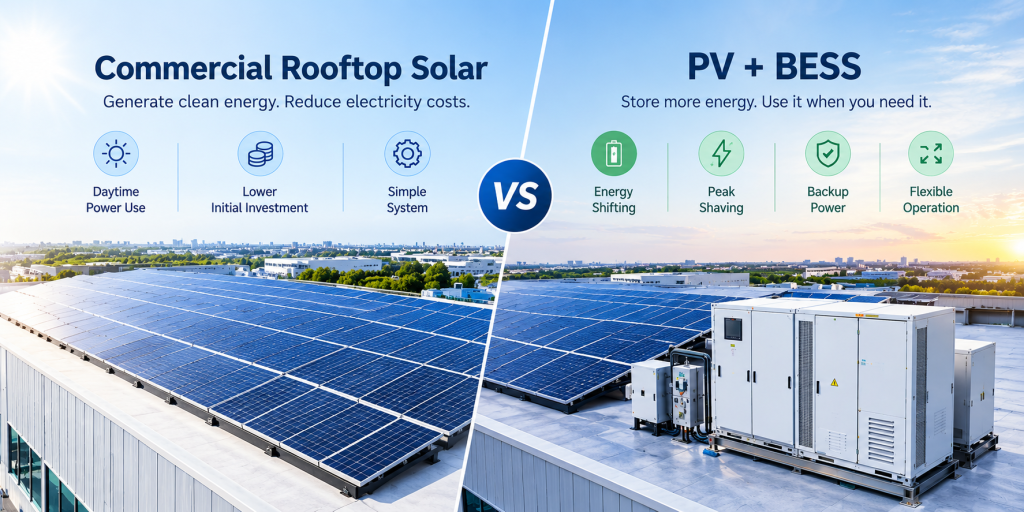
Rooftop PV may be suitable when daytime electricity consumption is high and predictable. PV + BESS may be more appropriate when the project needs solar energy shifting, peak demand management, backup power or greater control over energy usage.
The best starting point is not the battery capacity or number of الألواح الشمسية. It is the building's actual energy profile.
By evaluating electricity demand, solar generation, tariffs, grid limitations and future energy needs together, businesses can select a system configuration that fits their project rather than adding equipment that may not provide meaningful value.
الأسئلة الشائعة
1. Is commercial rooftop solar enough for a business?
For businesses with high daytime electricity consumption, a commercial rooftop solar system may be sufficient to offset a significant portion of grid electricity. The right choice depends on the facility’s load profile, operating hours, roof space and local electricity rates.
2. When should a commercial solar project add battery storage?
Battery storage can become more useful when a facility has significant evening demand, high peak-demand charges, excess solar generation or a need for backup power. The battery should have a clear operational purpose rather than being added simply as an extra component.
3. Is PV + BESS worth the additional investment for a commercial building?
It depends on the project's electricity tariff, load profile, battery cost, operating strategy and expected savings. A detailed analysis using actual electricity consumption data is more useful than relying on a general payback period. Recent discussions among commercial energy users repeatedly emphasize evaluating the actual site economics before adding storage.
4. Can a battery reduce commercial demand charges?
Yes. In markets where electricity bills include demand charges based on peak power consumption, BESS can discharge during high-load periods to reduce grid demand. However, the battery must have sufficient power capacity and be controlled according to the site's actual load profile.
5. Does a commercial battery need to be sized to cover the entire building?
No. A commercial battery does not necessarily need to supply every load in the facility. For backup applications, businesses can identify critical loads first and size the battery and inverter around those requirements. This approach can significantly affect the overall system configuration.
6. What information is needed to decide between solar and PV + BESS?
Useful information includes at least 12 months of electricity bills or interval consumption data, peak demand, operating hours, electricity tariffs, roof area, existing PV capacity and expected future loads. Actual consumption data provides a much stronger basis for system sizing and financial analysis.
7. What should businesses compare when evaluating BESS quotations?
Businesses should look beyond the battery capacity and compare the complete system, including battery cells, usable energy, PCS power, BMS, EMS, cooling, fire protection, warranty, certifications, installation, grid connection and other project costs. Recent Reddit discussions specifically point out that apparently similar commercial BESS quotations may contain significantly different system scopes and costs.