


Table des matières
As energy storage becomes increasingly important for commercial, industrial, and renewable energy projects, choosing the right Battery Energy Storage System (BESS) is an important decision. Two common options are Outdoor BESS and Containerized BESS.
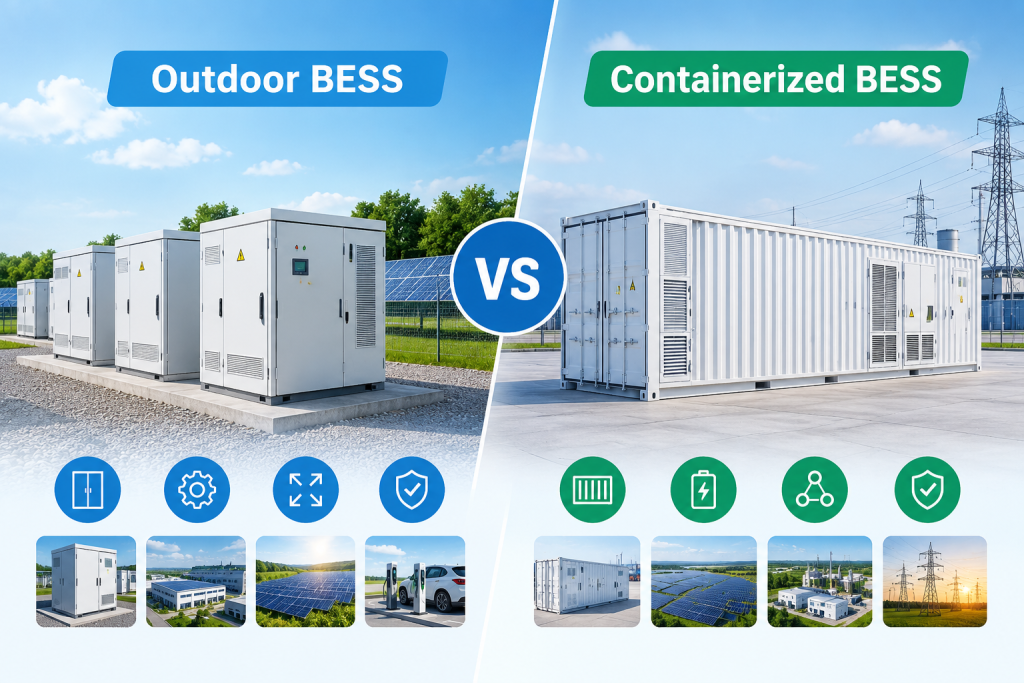
Although both systems can support peak shaving, renewable energy integration, backup power, and load management, their design, installation, and ideal applications can be quite different. So, which one is better for your project?
The answer depends mainly on your required capacity, available space, installation conditions, budget, and future expansion plans.
Qu'est-ce qu'un BESS d'extérieur ?
Outdoor BESS usually refers to battery storage systems installed in weather-resistant outdoor cabinets. A typical system may integrate battery modules, Battery Management System (BMS), Power Conversion System (PCS), Energy Management System (EMS), cooling, and fire protection.

For businesses looking for a compact outdoor BESS solution, cabinet-based systems can offer greater flexibility. They can be installed around factories, commercial buildings, solar sites, and EV charging facilities without requiring a large dedicated container area.
Another advantage is modularity. Businesses can deploy an initial capacity and expand the system later by adding additional battery cabinets when energy demand increases.
Qu'est-ce qu'un système de stockage d'énergie par batterie conteneurisé ?
Containerized BESS places battery racks and supporting equipment inside a standardized container. The container can integrate batteries, PCS, cooling, fire protection, and other components into a centralized energy storage unit.
A high-capacity containerized BESS is generally more suitable for large-scale applications, such as industrial parks, utility projects, large solar farms, and microgrids. Instead of installing many separate cabinets, multiple battery racks can be organized inside one or more containers.

However, containerized systems usually require more space and site preparation. Transportation, foundations, lifting equipment, fire safety distances, and maintenance access should all be considered during project planning.
BESS d'extérieur vs BESS en conteneur : Principales différences
| Factor | Outdoor BESS | Containerized BESS |
|---|---|---|
| Typical application | Small and medium C&I projects | Large C&I and utility projects |
| Footprint | More compact | Requires larger dedicated area |
| Capacity expansion | Flexible and modular | Usually added by container |
| Installation | Relatively simple | Requires more site preparation |
| Transportation | Individual cabinets are easier to handle | Requires container transportation |
| Maintenance | Easy access to individual units | Centralized equipment access |
| Best suited for | Flexible deployment | Large-capacity energy storage |
Quel BESS est le meilleur pour votre projet ?
There is no single answer for every project.
Outdoor BESS may be a better choice when space is limited, the required capacity is moderate, or the project needs flexible and phased expansion.
Containerized BESS can be more suitable when a project requires large-scale energy storage and has sufficient space for installation, transportation, maintenance, and safety requirements.
The most important factor is not simply battery capacity. Project owners should also consider the load profile, peak demand, site layout, operating environment, safety requirements, and long-term expansion plans.
In short, outdoor cabinet systems focus more on flexibility and compact deployment, while containerized systems are generally better suited to centralized, high-capacity applications. Understanding these differences before purchasing can help businesses choose a BESS configuration that delivers better performance and overall project economics.
FAQ
1. Quelle est la différence entre un BESS extérieur et un BESS conteneurisé ?
Le BESS d'extérieur est généralement installé dans des armoires à batteries résistantes aux intempéries, tandis que le BESS conteneurisé intègre des racks de batteries et les équipements associés à l'intérieur d'un conteneur. Les systèmes extérieurs sont généralement plus compacts et flexibles, tandis que les systèmes conteneurisés sont couramment utilisés pour des projets de plus grande capacité.
2. Le BESS extérieur est-il meilleur que le BESS conteneurisé ?
Aucun des deux n'est universellement meilleur. Le BESS extérieur peut être plus adapté aux projets disposant d'un espace limité ou de besoins de stockage modérés, tandis que le BESS conteneurisé peut être un meilleur choix pour les projets de stockage d'énergie à grande échelle qui nécessitent une capacité de batterie centralisée.
3. Quel système de stockage d'énergie par batterie (BESS) est le meilleur pour les applications commerciales et industrielles ?
Both can be used for C&I energy storage. Outdoor BESS is often suitable for factories, commercial buildings, EV charging stations, and smaller distributed energy projects. Containerized BESS can be considered for larger factories, industrial parks, and projects requiring higher storage capacity.
4. Le système de stockage d'énergie par batterie (BESS) conteneurisé nécessite-t-il plus d'espace d'installation ?
Generally, yes. In addition to the container itself, the project needs sufficient space for transportation, installation, maintenance access, safety distances, and other supporting infrastructure.
5. Quel système est le plus facile à installer, le BESS extérieur ou le BESS conteneurisé ?
Outdoor BESS can be relatively easier to deploy because individual battery cabinets are more compact and flexible to position. Containerized BESS usually involves additional requirements for transportation, foundations, lifting, and site preparation.
6. Le système de stockage d'énergie par batterie (BESS) conteneurisé est-il adapté au stockage de l'énergie solaire ?
Yes. Containerized BESS can be integrated with large solar PV projects to store excess renewable energy and provide power when solar generation is unavailable. It is particularly suitable when the project requires centralized, high-capacity energy storage.
7. Le BESS d'extérieur et le BESS conteneurisé peuvent-ils être utilisés pour les mêmes applications ?
There is some overlap. Both can support applications such as peak shaving, renewable energy integration, backup power, and load management. The main difference is how the system is configured and scaled to meet the specific project requirements.