


Índice de contenidos
As commercial EV charging becomes more common at factories, warehouses, logistics centers, offices and fleet depots, businesses are paying more attention to what happens when grid power is unavailable or limited. EV chargers can create significant power demand, particularly when multiple vehicles are charging at the same time. This raises an important question: Can BESS provide backup power for commercial EV charging?
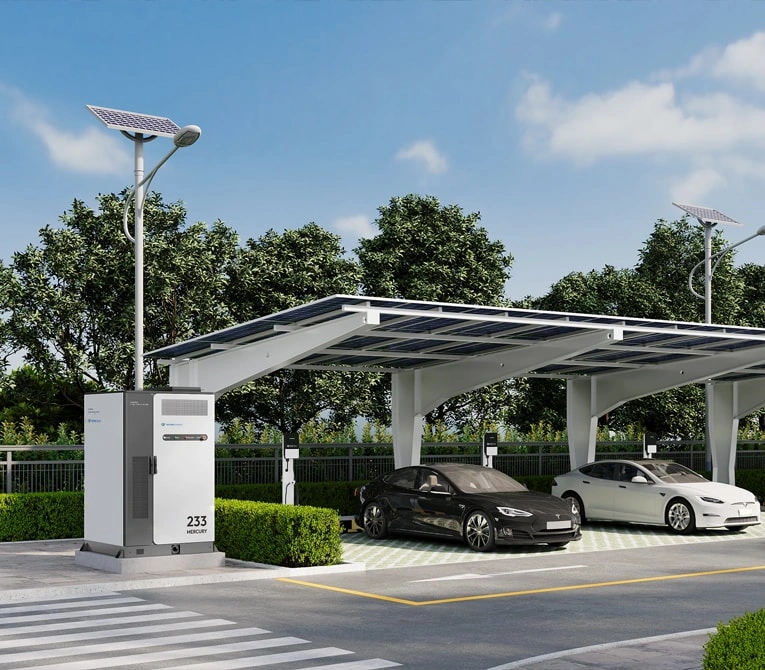
The short answer is yes, but the actual capability depends on the battery capacity, inverter power, charging load, system architecture and the type of backup required. A properly designed commercial BESS for EV charging can provide backup energy, manage charging loads and improve the flexibility of a commercial energy system.
Why Backup Power Matters for Commercial EV Charging
For many businesses, EV charging is becoming part of daily operations rather than an occasional service. Logistics companies may need to charge delivery vehicles overnight, factories may operate employee charging stations, and commercial fleets may depend on charging infrastructure to keep vehicles available. A grid outage can therefore affect both transportation operations and business continuity.
The challenge is that EV chargers can require substantial power. A single AC charger may have a relatively moderate load, while DC fast chargers can require much higher power. If several chargers operate simultaneously, the total demand can quickly become significant. This is where battery storage can provide an additional layer of energy flexibility.
How Can BESS Support EV Charging During a Grid Outage?
A BESS backup power system for EV charging typically stores electricity before it is needed and supplies power when the grid becomes unavailable or when grid capacity is restricted.
A typical system may include:
Solar PV → BESS → EV Chargers → Vehicles
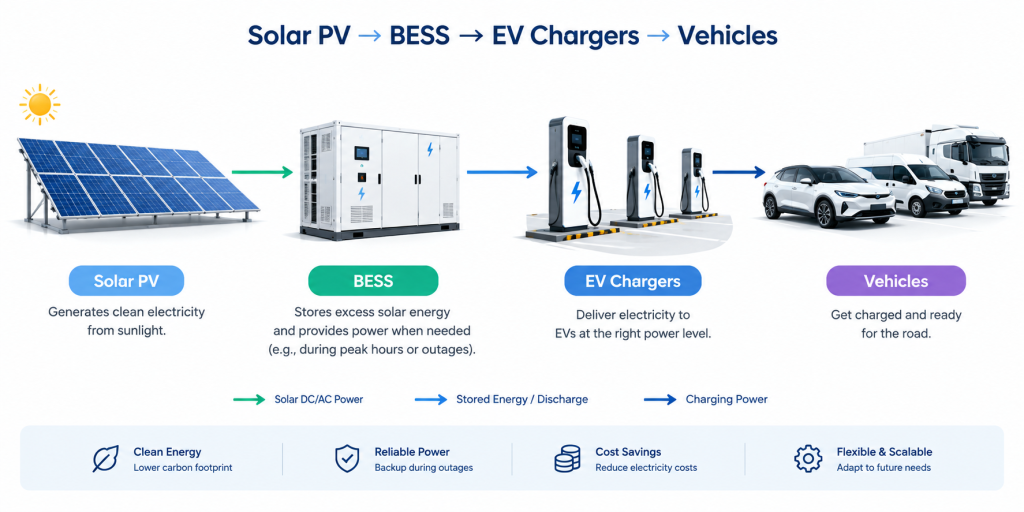
with the grid connected as another energy source.
During normal operation, the battery can be charged from solar PV or the grid, depending on the system design and energy management strategy. When a grid outage occurs, the BESS can supply power to designated EV chargers and other critical loads if the system has appropriate backup functionality. However, backup does not necessarily mean that every charger can continue operating at full power. The available charging power depends on the BESS inverter rating and the amount of stored energy.
Battery Capacity and Charging Power Are Different
One of the most important considerations is the difference between kW and kWh.
- kW represents how much power the BESS can deliver at a given moment.
- kWh represents how much energy the battery can store.
For example, a commercial battery may have enough stored energy to support EV charging for several hours, but its inverter may not be powerful enough to operate multiple high-power DC chargers simultaneously. Therefore, EV charging backup design needs to consider both the charging load and the required backup duration.
Does BESS Need to Support All EV Chargers?
Not necessarily. For many commercial projects, supporting every charger at full output during an outage would require a much larger and more expensive energy storage system. Instead, businesses can identify critical charging loads and prioritize them.
For example, an EV fleet depot could prioritize several chargers for essential delivery vehicles while temporarily reducing the charging power of other stations. An energy management system can coordinate the available battery power and distribute it according to predefined priorities. This approach can make a commercial EV charging energy storage system more practical while maintaining essential charging services.
Can Solar PV and BESS Work Together for EV Charging?
Yes. Combining solar PV, BESS and EV charging can create a more flexible commercial energy system.
During the day, solar generation can supply building loads and EV chargers directly. Excess solar power can charge the battery. When solar production decreases, stored energy can be used for EV charging or other selected loads. During a grid outage, the battery can provide backup power if the system is designed for islanded or backup operation.
This configuration can be particularly useful for businesses with daytime solar generation and EV charging requirements that extend beyond peak solar production hours.
What About Fast EV Charging?
Fast charging introduces additional challenges because DC fast chargers can create high instantaneous power demand. For example, a site with several high-power chargers may require a substantial grid connection if all chargers operate simultaneously. Adding BESS can help manage these peaks by supplying part of the charging power from the battery rather than drawing the entire load from the grid. This can also allow the site to use intelligent charging strategies based on available grid capacity, battery SOC, solar generation and vehicle charging requirements.
What Should Businesses Consider Before Adding BESS?
Before selecting a BESS for commercial EV charging, businesses should evaluate:
- Number and type of EV chargers
- Charger power rating
- Expected simultaneous charging
- Daily charging energy requirements
- Required backup duration
- Existing grid capacity
- Solar PV capacity
- Battery power and energy capacity
- Critical charging loads
- Energy management requirements
- Future EV fleet expansion
These factors are more important than simply choosing the largest battery available.
Is BESS Backup Worth Considering for Commercial EV Charging?
BESS can provide more than backup power. When properly integrated with PV, EV chargers and the grid, it can also support peak demand management, solar energy utilization and flexible charging control.
For commercial facilities, the most suitable configuration depends on the site's actual load profile and operational priorities. Some businesses may need full backup for selected chargers, while others may benefit more from partial backup combined with intelligent load management.
Conclusión
Can BESS provide backup power for commercial EV charging? Yes, but the system must be properly sized and configured for the required charging load and backup duration. For factories, warehouses, fleet depots and other C&I facilities planning PV + BESS + EV Charging, designing these systems together from the beginning can provide greater flexibility for both current operations and future EV charging expansion.