


المحتويات
For factories, mines, hospitals, and industrial facilities, reliable electricity is essential for maintaining production and protecting critical equipment. However, grid outages, rising electricity costs, and high diesel consumption can make energy management increasingly challenging. A commercial microgrid combining solar PV, battery storage, and generator backup offers a flexible solution to improve power reliability while reducing operating costs.
The key is to select compatible equipment and design the system around actual electricity demand, rather than simply choosing equipment based on rated power.
1. Determine the Solar PV System Capacity
The first step is to evaluate the facility's electricity consumption, available installation space, and local solar resources. A 1MW commercial solar power system may be suitable for a large factory or industrial facility, but the appropriate PV capacity depends on daytime demand, roof or ground space, and grid export restrictions.
For example, a factory operating mainly during daylight hours can use solar power directly to supply production equipment, lighting, and ventilation. Facilities operating multiple shifts may benefit from combining solar generation with battery storage to use more of their renewable electricity after sunset.
Solar panel selection should consider module wattage, efficiency, temperature performance, and available installation area. Inverters must also be sized to match the PV array and the intended AC power output.
Before finalizing the design, compare expected solar generation with the facility's hourly load profile. This helps determine how much electricity can be consumed directly, how much excess energy can be stored, and whether additional backup power is required.
2. Select a High-Voltage Battery Energy Storage System
A high voltage battery energy storage system can store excess solar electricity for later use, reduce peak demand, and provide backup power when configured with compatible power conversion equipment.
Battery selection involves two key ratings: power capacity, measured in kilowatts (kW), and energy capacity, measured in kilowatt-hours (kWh). Power determines how much equipment the battery can support at one time, while energy determines how long it can supply that load.
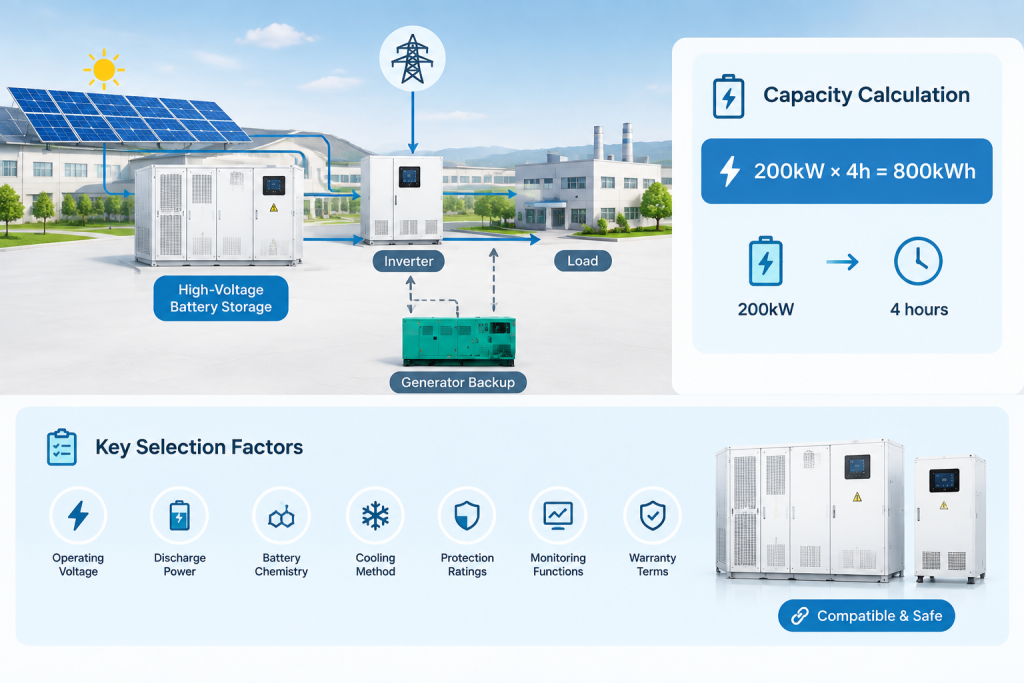
For example, if a factory needs to support a 200kW critical load for four hours, the basic usable energy requirement is:
200kW × 4 hours = 800kWh
The actual installed battery capacity should account for usable state-of-charge limits, conversion losses, reserve requirements, and battery degradation.
When comparing commercial battery storage products, consider operating voltage, continuous discharge power, battery chemistry, cooling method, protection ratings, monitoring functions, and warranty terms. The battery and inverter must be compatible, and the system should meet applicable electrical and fire safety requirements.
3. Choose a Solar Hybrid Inverter with Generator Backup
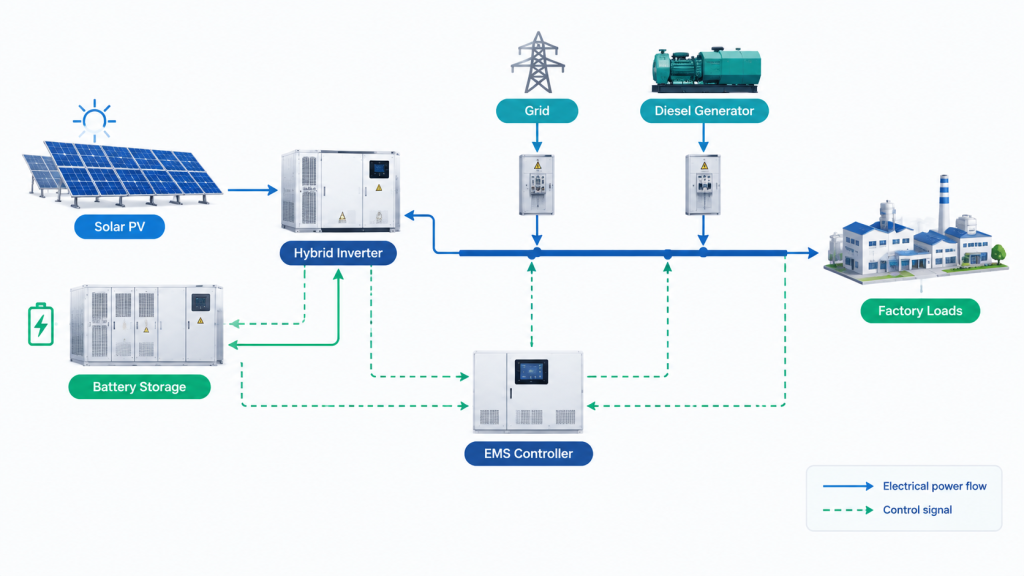
A solar hybrid inverter with generator backup can coordinate solar generation, battery charging and discharging, and generator operation when the selected equipment supports these functions.
During normal operation, the system can prioritize solar power for facility loads and charge the battery using surplus generation. During periods of low solar output or high demand, the battery can discharge to reduce grid electricity consumption or support designated loads.
If the utility grid fails, the system must be specifically designed for islanded operation to maintain power independently. When battery reserves fall below a preset threshold, the energy management system may start the generator, provided automatic start and control functions are supported.
Generator sizing should account for critical-load demand, motor-starting currents, power factor, ambient temperature, site altitude, and the generator's operating limits. The design must also prevent unsafe backfeeding and coordinate generator output with the inverter and battery system.
Before purchasing equipment, confirm generator compatibility, communication protocols, transfer arrangements, black-start capability, and the required backup response time.
4. Integrate Solar, Battery Storage, Grid, and Generator
The microgrid controller or energy management system (EMS) is responsible for coordinating the different power sources. A well-designed system should define how energy flows under normal operation, peak demand, grid outages, and prolonged periods of low solar generation.
For example, during sunny periods, solar electricity can supply facility loads and charge the battery. During evening peak demand, stored energy can reduce grid imports. During an outage, the microgrid can disconnect from the utility and supply designated critical loads. If solar generation and battery reserves become insufficient, the generator can provide additional power.
These operating strategies should be established during the engineering phase and tested during commissioning. Protection relays, switchgear, grounding, synchronization, load shedding, and grid-interconnection requirements must all be considered.
Not every hybrid inverter automatically supports all these functions. Confirm the complete system architecture and control capabilities before selecting equipment.
5. Evaluate Costs, Reliability, and Future Expansion
The lowest equipment purchase price does not necessarily deliver the lowest lifetime operating cost. A complete project evaluation should include solar panels, inverters, batteries, generator integration, installation, electrical protection, monitoring, maintenance, and replacement costs.
Compare different configurations using estimated solar self-consumption, grid electricity prices, generator fuel consumption, expected outage duration, and battery cycling requirements.
It is also worth planning for future expansion. If production capacity is expected to grow, the design may need additional PV capacity, battery storage, inverter power, or generator capacity. Modular equipment and a flexible control architecture can make future upgrades easier.
خاتمة
Designing a 1MW commercial microgrid requires more than selecting solar panels and batteries. The system must balance renewable energy generation, storage capacity, generator backup, operating costs, and power reliability.
By choosing a suitable commercial solar power system, a compatible high-voltage battery energy storage system, and a solar hybrid inverter with generator backup, businesses can develop a microgrid tailored to their operational requirements.
Toyon Energy provides customized commercial solar and energy storage solutions for industrial applications. Contact our team to discuss your facility's electricity demand, backup requirements, and project specifications.
الأسئلة الشائعة
1. How Do You Calculate the Battery Capacity Needed for a Factory?
Battery capacity depends on the critical load and required backup duration. For example, a factory that needs to support a 200kW load for four hours requires 800kWh of usable energy before accounting for system losses, reserve capacity, and battery degradation. For accurate sizing, evaluate hourly load data, peak demand, and the equipment that must remain operational during an outage.
2. Is a Larger Battery Always Better for Commercial Solar Storage?
No. A larger battery increases upfront investment and may take longer to pay back if its capacity is rarely used. The right size depends on backup requirements, solar generation, peak electricity demand, and the battery's expected daily utilization.
For factories, it is often more economical to size the battery around defined critical loads rather than attempting to power the entire facility indefinitely.
3. Can a High-Voltage Battery Energy Storage System Power Heavy Industrial Equipment?
Yes, if the battery, inverter, and electrical distribution system are properly sized for the required loads. However, battery energy capacity alone does not determine whether heavy equipment can operate.
Engineers must also evaluate continuous discharge power, motor-starting current, surge demand, power factor, and inverter overload capability. Large motors or compressors may require additional starting-current management.
4. How Can a Factory Reduce Battery Storage Payback Time?
Analyze potential savings against equipment costs, efficiency losses, maintenance, and battery degradation. If a portion of the battery capacity must remain reserved for emergencies, exclude that capacity from assumptions about routine energy savings.
5. What Should Businesses Check Before Purchasing a Commercial Battery Storage System?
Before purchasing, verify battery voltage, usable energy capacity, continuous power output, inverter compatibility, cooling, protection ratings, warranty coverage, and monitoring capabilities.
Also ask who will handle commissioning, remote monitoring, preventive maintenance, and troubleshooting. For industrial facilities, dependable technical support and clear responsibility for system performance can be as important as the initial equipment price.
6. Is Battery Storage Better Than a Diesel Generator for Factory Backup?
Neither option is universally better. Batteries can respond quickly and support peak shaving, while diesel generators can provide power for extended outages as long as fuel is available.
A hybrid system combining solar, battery storage, and a generator may offer a practical balance between daily energy savings and long-duration backup. The best configuration depends on outage frequency, fuel costs, and the consequences of production downtime.