

Table of Contents
In Today’s Rapidly Growing Green Energy Market, Commercial & Industrial Rooftop Distributed PV Projects Have Become an Important Choice for Enterprises
As investment in green energy continues to accelerate, commercial and industrial (C&I) rooftop distributed photovoltaic (PV) projects have become an important solution for enterprises to reduce energy consumption, lower electricity costs, and support carbon reduction goals. They also play a significant role in promoting the development of new power systems.
As a holding subsidiary of Tongyuan Environment Group, a listed company, Toyon Energy has accumulated extensive EPC experience in the photovoltaic industry and possesses a deep understanding of compliance requirements throughout the project development and construction process. This article systematically outlines the key compliance points for C&I solar project construction, helping enterprises move steadily and confidently in the new energy era.
1. Preliminary Preparation Stage
Before project implementation, the team conducts detailed investigations into project site selection, construction conditions, power transmission capability, and local energy consumption markets. During the early stage of project development, Toyon Energy usually carries out the following due diligence work:
- Rooftop Property Rights Verification: Ensure clear ownership without mortgage, seizure, or other legal restrictions.
- Building Compliance Review: Verify property ownership certificates, planning permits, and construction permits.
- Load-Bearing Assessment: Entrust professional institutions to conduct rooftop load capacity testing.
- Electricity Consumption Analysis: Analyze the owner’s electricity usage patterns and evaluate PV consumption capability.
2. Investment Filing Process
Filing Requirements
Filing Entity:
The project must be filed by the investing enterprise itself, and nominee holdings are prohibited.
Core Required Documents
- Project Information: The project name should include the enterprise name, capacity, and “distributed photovoltaic”; specify construction location, project scale (AC/DC side), and grid connection mode.
- Enterprise Qualification Documents: Business license and legal representative ID copies.
- Site Ownership Documents: Property ownership certificate or land certificate; for leased rooftops, a lease agreement must be provided, clearly defining the lease term, scope, and rights and obligations.
- Technical Proposal: A brief feasibility study report including design plans, equipment selection, and power generation forecasts.
Filing Procedures
- Fill in project information and upload documents through the online platform.
- Receive review feedback within 1–3 working days.
- Download the filing certificate after approval.
Grid Connection Application Required Documents
- Grid connection application form
- Project filing certificate
- Enterprise qualification documents
- Site ownership documents
- Project design documents (electrical drawings, lightning protection plans, etc.)
Site Inspection & Connection Plan Formulation
- Site inspection is usually conducted within 5–10 working days after application submission.
- The grid company issues a connection plan within 10–20 working days.
- The enterprise reviews and confirms the grid connection plan.
3. Construction Stage: Qualification & Quality Control
The construction phase is a “high-risk area” for compliance issues in C&I solar projects. Qualification defects and non-compliant bidding procedures are two major risk areas that require strict control. In addition, grid connection and commissioning acceptance are critical to ensuring compliant grid integration and stable project revenue.
EPC Qualification Requirements: Three Essential Certificates
When selecting an Engineering, Procurement, and Construction (EPC) contractor, three core qualifications must be carefully verified:
- Design & Construction Dual Qualifications: According to regulations of the Ministry of Housing and Urban-Rural Development, EPC contractors must possess both design and construction qualifications corresponding to the project scale to ensure full-process service capability.
- Electric Power Facility License: A mandatory qualification for electrical engineering construction activities.
- Safety Production License: A key certification ensuring construction safety compliance and minimizing accident risks.
Toyon Energy’s Qualification Advantages
Toyon Energy, a wholly owned subsidiary of Hefei Toyon Energy, possesses the following qualifications:
- Electric Power Facility License
- Safety Production License
- Class 333 Installation, Repair & Testing License for Electric Power Facilities
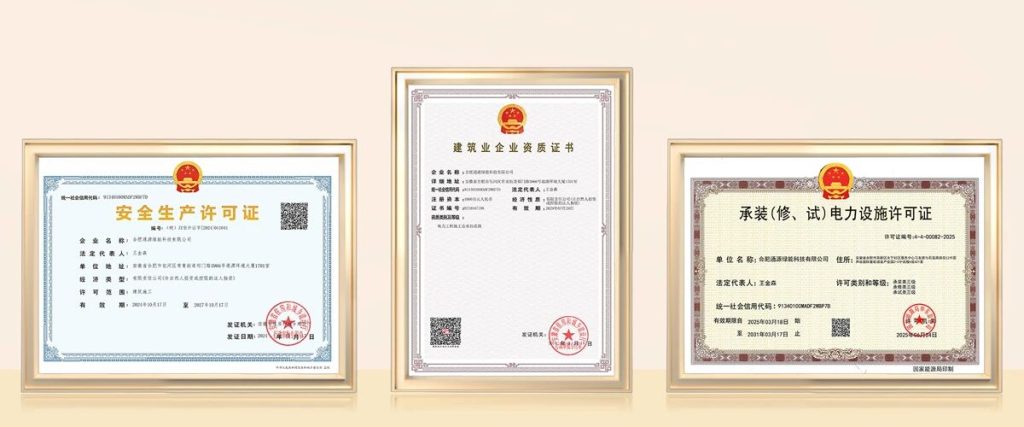
In addition, the company has passed three major management system certifications to ensure construction safety:
Environmental Management System Certification
This certification ensures environmentally friendly practices throughout the project lifecycle, from material selection and waste disposal to energy consumption and ecological protection.
Occupational Health & Safety Management System Certification
This demonstrates our commitment to protecting construction personnel through systematic safety management, including high-altitude operation protection, equipment operation standards, health monitoring, and emergency response systems.
Quality Management System Certification
The concept of “Quality Equals Safety” is integrated into every stage of construction. From support structure load-bearing strength to cable insulation performance, every component undergoes strict quality inspection to prevent safety incidents caused by quality defects.
4. Grid Connection & Commissioning Acceptance
For commercial and industrial enterprises, the “self-consumption with surplus electricity fed into the grid” model is the mainstream approach for rooftop PV projects. Enterprises can reduce electricity costs through self-generated solar power while earning additional income by selling surplus electricity to the grid. To achieve compliant grid integration, the following standardized procedures must be completed:
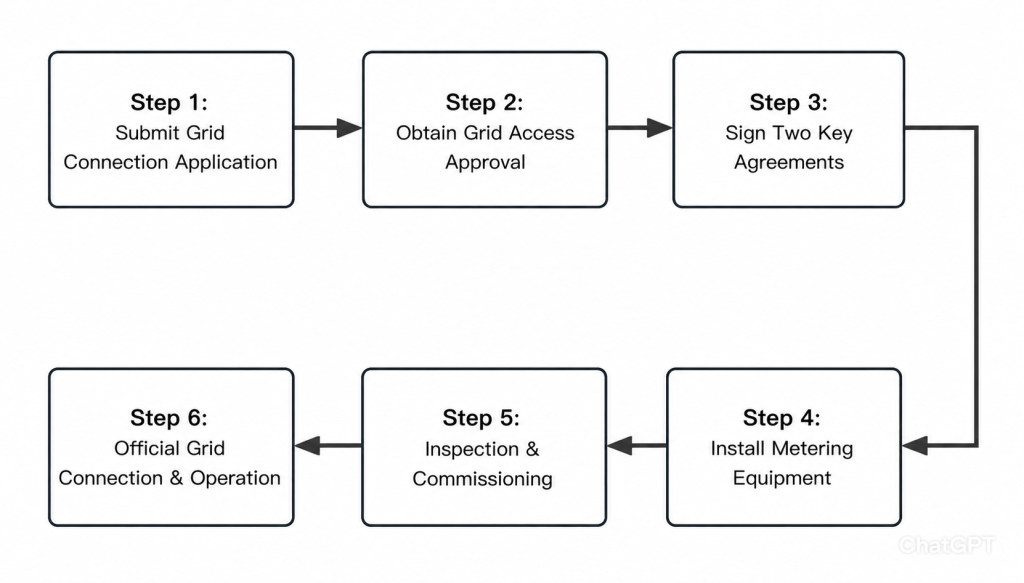
Step 1: Submit Grid Connection Application
When project construction is nearing completion, submit the grid connection acceptance and commissioning application to the local grid company, together with project filing documents, equipment parameter lists, and grid connection plans.
Step 2: Obtain Grid Access Approval
The grid company will issue a grid access plan and approval based on project capacity and local grid load conditions, specifying key details such as the connection point and electricity metering method.
Step 3: Sign Two Core Agreements
Power Purchase & Sales Agreement
Defines electricity pricing standards, settlement cycles, and payment methods for surplus electricity sold to the grid.
Grid Dispatch Agreement
Clarifies the coordination mechanism between the grid operator and the PV system, including load adjustments and emergency response requirements.
Step 4: Install Metering Devices
The grid company or its authorized units will install electricity metering equipment that complies with national standards to accurately record self-consumed electricity and surplus electricity exported to the grid.
Step 5: Inspection & Commissioning
The grid company conducts on-site inspections to verify whether equipment meets grid connection technical standards and performs commissioning tests to ensure stable power output.
Step 6: Official Grid Connection & Operation
After passing the inspection, the grid company issues the “Grid Connection Acceptance Opinion,” and the project officially enters the operational stage. Solar-generated electricity can then be used for self-consumption, while surplus electricity can be sold to the grid according to the agreement terms.
5. Toyon Energy: Your Comprehensive Solar Solution Partner
The development and construction of C&I distributed PV projects is a systematic process that requires balancing policy compliance, technical feasibility, and economic efficiency. From site evaluation and filing approval in the early stage, to construction management and quality control during implementation, and finally to grid connection acceptance and operation maintenance, every step requires professional expertise and extensive project experience.
As a local photovoltaic EPC enterprise, Toyon Energy has been deeply engaged in the distributed solar industry for many years and has accumulated rich project experience. We always adhere to customer-oriented service, technology-driven innovation, and quality & safety as our foundation, providing customers with comprehensive one-stop solar power solutions.
We welcome enterprises interested in developing distributed photovoltaic projects to contact us. Toyon Energy’s professional team will provide detailed policy consultation and customized technical solutions to help create high-quality solar power projects together.