


Table of Contents
For factories, warehouses, and other commercial facilities, installing solar panels is only the first step. Businesses also need to know whether their systems are generating the expected amount of electricity, whether equipment is operating normally, and when maintenance is required.
A commercial solar monitoring system helps answer these questions by collecting operating data, displaying performance trends, and identifying unusual conditions. Instead of relying only on electricity bills or occasional site inspections, project owners can track system performance throughout the year.
1. How Is Solar System Data Collected?
Solar monitoring begins with data collection from key equipment, including solar inverters, electricity meters, sensors, and communication devices. Depending on the system design, monitoring may cover the entire PV system, individual inverters, or specific strings of solar panels.
These devices measure parameters such as power output, energy generation, voltage, current, and equipment status. Weather sensors may also record solar irradiance and temperature, helping operators understand how environmental conditions affect production.
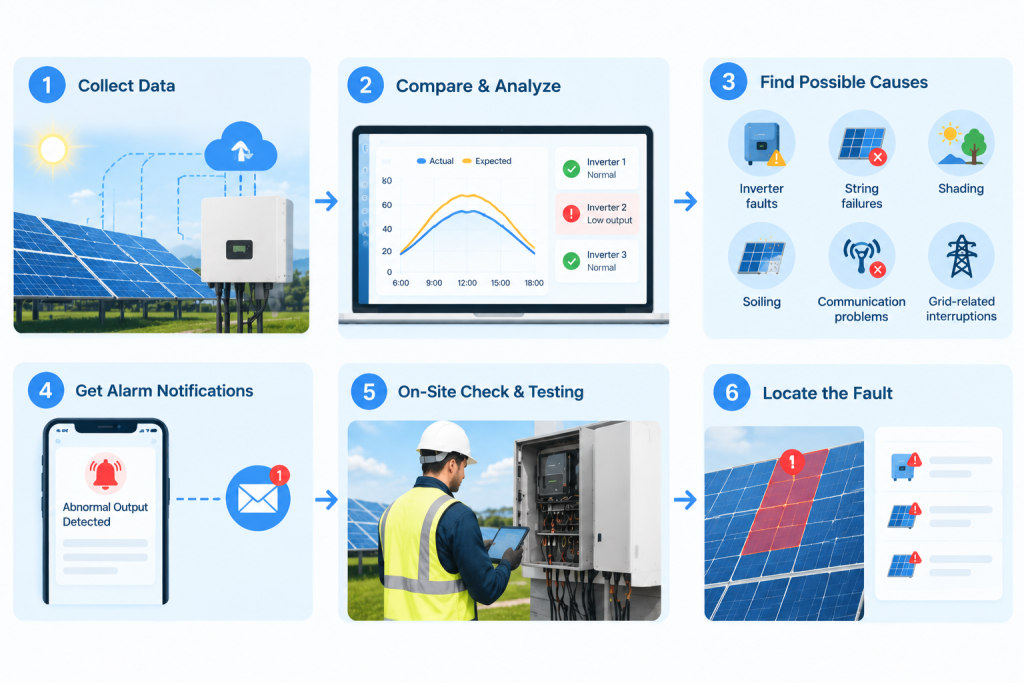
The collected information is transmitted through a communication gateway or network to a monitoring platform. Facility managers and maintenance teams can then access dashboards and reports remotely, provided the system has a suitable communication connection.
2. How Does Solar Panel Performance Monitoring Identify Problems?
Collecting data is useful, but understanding what the data means is even more important. Solar panel performance monitoring compares actual generation with expected output, historical performance, and, where available, comparable equipment operating under similar conditions.
For example, if one inverter produces significantly less power than similar inverters on a sunny day, the monitoring platform may flag an abnormality. Possible causes include inverter faults, string failures, shading, soiling, communication problems, or grid-related interruptions.
Alarm notifications can help maintenance teams investigate issues before they remain unnoticed for extended periods. However, an alert does not automatically identify the exact cause. On-site inspection, electrical testing, or equipment diagnostics may still be necessary.
Monitoring also has different levels of detail. Inverter-level data can reveal major equipment problems, while string-level monitoring can help locate underperforming sections more precisely. Individual-panel monitoring may be available with suitable module-level electronics, but it is not included in every commercial installation.
3. Which Performance Indicators Should Businesses Track?
For commercial projects, several indicators are particularly useful:
- Daily and monthly energy generation: Shows how much electricity the system produces over time.
- System availability: Indicates how often the system is operational and capable of generating power.
- Performance ratio (PR): Compares actual energy production with modeled production under the measured solar conditions.
- Inverter and string status: Helps identify equipment faults and uneven performance.
- On-site energy consumption: Shows how solar generation aligns with the facility's electricity demand.
These measurements help businesses evaluate commercial PV system performance more accurately. A low production figure does not necessarily mean the panels are faulty; cloudy weather, seasonal changes, shading, and grid interruptions can also affect output.
4. Can Monitoring Improve Commercial Solar ROI?
Monitoring does not directly repair equipment or guarantee higher savings. Its value comes from helping businesses identify losses, prioritize maintenance, and make informed operational decisions.
For example, if a factory's solar generation drops unexpectedly, the operations team can review inverter alarms and production trends before arranging an inspection. This can reduce the time spent searching for problems and help maintenance resources focus on issues with the greatest operational impact.
For projects combining solar panels with battery energy storage, monitoring can provide additional insight into battery charging and discharging, energy flows, and the relationship between solar generation and facility demand, depending on the equipment and platform.
5. What Should Businesses Check Before Choosing a Monitoring System?
Before selecting a solution, project owners should confirm equipment compatibility, communication requirements, data access, alarm configuration, reporting functions, and remote troubleshooting capabilities. For multi-site businesses, centralized monitoring and consistent reporting can also simplify system management.
It is equally important to clarify whether the platform supports inverter-level or string-level analysis and whether it can integrate with the project's battery system or energy management system (EMS).
Conclusion
Solar monitoring turns operating data into practical information for commercial solar management. By tracking generation, comparing performance, and highlighting abnormal conditions, businesses can make better-informed maintenance decisions and evaluate whether their PV systems are delivering the expected benefits.
For factories and other commercial facilities planning a new installation or a solar-plus-storage project, monitoring capabilities should be considered during system design—not only after commissioning. Toyon Energy supports commercial solar and battery storage projects with solutions tailored to different facility requirements.