


Table of Contents
As renewable energy adoption continues to grow, more homeowners and businesses are looking for reliable battery energy storage solutions to reduce electricity costs, improve energy independence, and provide backup power during outages. However, choosing the right battery system can be challenging.
Two common options in the market are stackable battery systems and traditional fixed battery storage systems. So, which energy storage solution is better? The answer depends on your energy needs, installation environment, expansion plans, and budget.
This guide compares stackable batteries vs traditional batteries to help you choose the right modular energy storage system for your solar power project.
What Is a Stackable Battery System?
A stackable battery system is a modular energy storage solution that allows multiple battery modules to be connected together to increase storage capacity. Instead of purchasing a fixed-capacity battery system, users can start with a smaller battery size and add more modules when their energy demand increases.
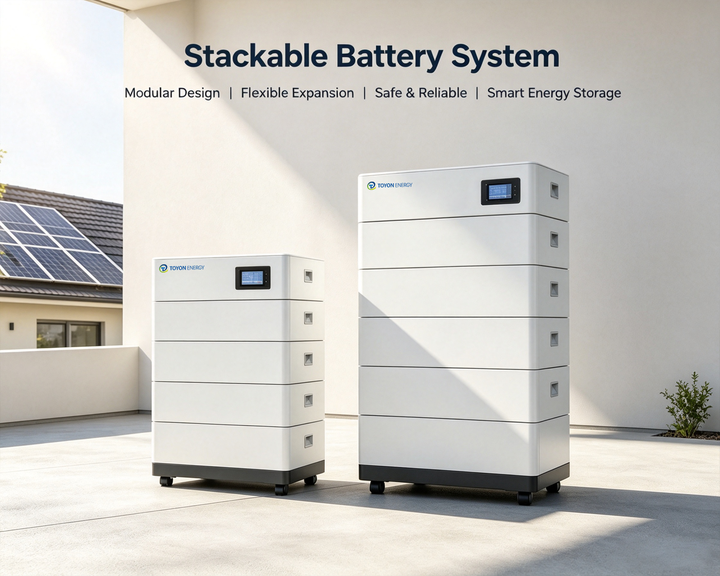
For example, a homeowner may install a 10kWh stackable battery system today and expand it to 20kWh or 30kWh in the future without replacing the entire system.
Common applications include:
- Residential solar battery storage systems
- Off-grid solar systems
- Small commercial energy storage
- Microgrid applications
Stackable Battery vs Traditional Battery: Key Differences
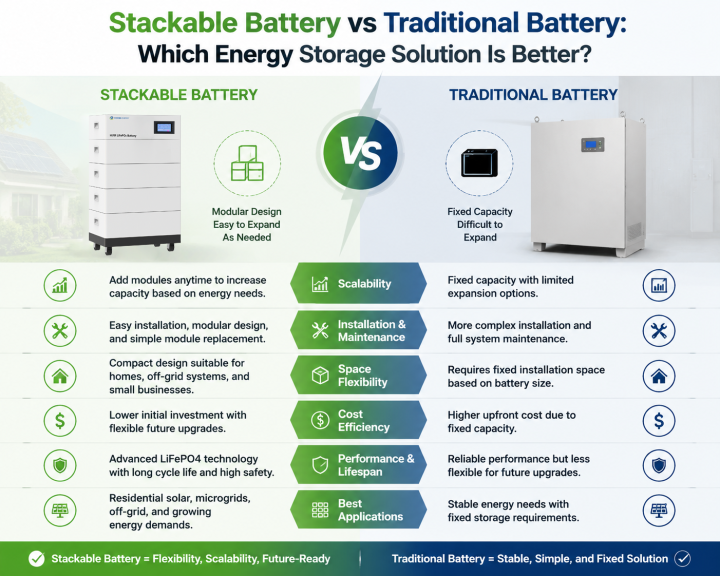
When comparing a stackable battery vs traditional battery, the main differences are scalability, installation flexibility, cost efficiency, and long-term adaptability. The following table highlights the key differences between these two energy storage solutions.
| Comparison Factor | Stackable Battery | Traditional Battery |
| Scalability | Add battery modules anytime to expand capacity based on energy needs. | Fixed capacity with limited expansion options. |
| Installation & Maintenance | Easy installation, modular design, and simple module replacement. | More complex installation and full system maintenance. |
| Space Flexibility | Compact design suitable for homes, off-grid systems, and small businesses. | Requires fixed installation space based on battery size. |
| Cost Efficiency | Lower initial investment with flexible future upgrades. | Higher upfront cost due to fixed capacity. |
| Performance & Lifespan | Advanced LiFePO4 technology with long cycle life and high safety. | Reliable performance but less flexible for future upgrades. |
| Best Applications | Residential solar, microgrids, off-grid, and growing energy demands. | Stable energy needs with fixed storage requirements. |
1. Flexibility and Scalability
One of the biggest advantages of a stackable lithium battery is scalability.
Traditional battery systems usually come with a fixed capacity. If your energy demand increases, you may need to replace the entire battery system with a larger model.
A stackable battery solution allows users to:
- Add additional battery modules anytime
- Adjust storage capacity according to energy consumption
- Avoid unnecessary upfront investment
This makes stackable batteries an ideal choice for homeowners who plan to install more solar panels, add electric vehicles, or increase electricity usage in the future.
2. Installation and Maintenance
Traditional battery systems often require complex installation because the entire battery unit needs to be configured at once.
In comparison, modular stackable battery systems are designed for easier installation. Individual battery modules can be connected together quickly, reducing installation time and maintenance complexity.
Advantages include:
- Plug-and-play installation
- Flexible system configuration
- Easier replacement of individual modules
- Reduced maintenance costs
For installers and solar companies, stackable batteries provide a more convenient solar battery storage solution.
3. Space Utilization and Design Flexibility
Space is an important factor for residential and commercial energy storage projects.
Traditional batteries usually require a dedicated installation area based on their fixed size and capacity.
Stackable batteries offer a more flexible design because modules can be arranged according to available space. They are suitable for:
- Homes with limited installation areas
- Remote off-grid locations
- Small businesses requiring backup power
The compact and modular design makes them a popular choice for modern home energy storage systems.
4. Cost Comparison: Which Battery Is More Affordable?
The initial cost of a traditional battery system may appear lower because it comes as a complete package. However, users often pay for unused capacity that they may not need immediately.
With a stackable battery system, customers can start small and expand gradually.
Benefits include:
- Lower initial investment
- Better return on investment
- Reduced replacement costs
- Flexible future upgrades
For many solar users, the best choice is not simply the cheapest battery, but the solution that provides long-term value.
5. Performance and Battery Life
Both stackable batteries and traditional batteries can provide reliable energy storage when using advanced lithium battery technology.
Most modern systems use LiFePO4 battery technology, which offers:
- Long cycle life
- High safety performance
- Better thermal stability
- Low maintenance requirements
The actual performance depends on battery quality, battery management system (BMS), installation conditions, and usage patterns.
Which Energy Storage Solution Should You Choose?
A stackable battery system is a better choice if you need:
✅ Future expansion capability
✅ Flexible energy storage capacity
✅ Residential solar energy storage
✅ Off-grid power solutions
✅ Lower upfront investment
A traditional battery system may be suitable if:
✅ Your energy demand is stable
✅ You already know the required capacity
✅ No future expansion is expected
For most modern solar applications, especially where electricity demand changes over time, stackable battery solutions provide greater flexibility and long-term benefits.
Why Stackable Battery Solutions Are the Future of Energy Storage
As energy costs increase and renewable energy becomes more popular, users need smarter and more adaptable storage solutions. Compared with traditional fixed batteries, stackable battery systems offer easier expansion, flexible installation, and better long-term scalability.
Whether for residential solar systems, commercial energy storage, or off-grid applications, modular battery technology provides a practical way to store renewable energy and achieve greater energy independence.
For customers looking for a future-ready solar battery storage system, a stackable lithium battery solution is becoming one of the most efficient and flexible choices available.
FAQs
1. What is the difference between a stackable battery and a traditional battery?
A stackable battery system uses a modular design that allows users to add more battery modules to increase storage capacity. A traditional battery usually has a fixed capacity and requires replacement when additional storage is needed.
Stackable batteries provide more flexibility, while traditional batteries are suitable for users with stable and predictable energy requirements.
2. Are stackable batteries better than traditional batteries?
For most modern solar energy applications, stackable batteries offer more advantages because they are scalable, easier to install, and adaptable to future energy needs.
They are especially suitable for:
Residential solar energy storage
Off-grid solar systems
Small commercial energy storage
Backup power applications
However, traditional batteries may still be a good choice for users who need a fixed-capacity solution.
3. How many stackable batteries do I need for my home?
The required number of battery modules depends on:
Daily electricity consumption
Solar system size
Backup power requirements
Appliance usage
Desired backup duration
For example, homes with higher electricity demand or longer backup requirements may need more battery modules.
4. Do stackable batteries cost more than traditional batteries?
The initial cost depends on battery capacity, brand, technology, and installation requirements.
Although stackable batteries may have a slightly higher cost per module, they can reduce long-term expenses because users can:
Start with a smaller system
Expand capacity when needed
Avoid replacing the entire battery system
This makes them a cost-effective solution for future energy growth.
5. Can stackable batteries be used for off-grid solar systems?
Yes. Stackable batteries are an excellent choice for off-grid solar energy storage systems.
They are commonly used in:
Remote homes
Rural areas
Island power systems
Remote commercial projects
Microgrid applications
Their modular design allows users to adjust storage capacity according to local energy demand.
6. What should I consider when choosing a stackable battery system?
Before purchasing a stackable battery solution, consider:
Battery capacity (kWh)
Expandability options
Battery chemistry
Compatibility with solar inverter
Safety certifications
Warranty period
Installation requirements
Choosing a flexible and reliable system ensures better long-term energy performance.
7. Why are stackable battery systems becoming more popular?
The growing demand for renewable energy and energy independence is driving the popularity of stackable batteries.
Compared with traditional fixed batteries, they offer:
Flexible capacity expansion
Easier installation
Better space utilization
Future-ready energy storage
As residential and commercial energy needs continue to change, modular battery storage systems are becoming a preferred solution.